 |
Business-Managed Democracy » Introduction » Business Mobilisation |

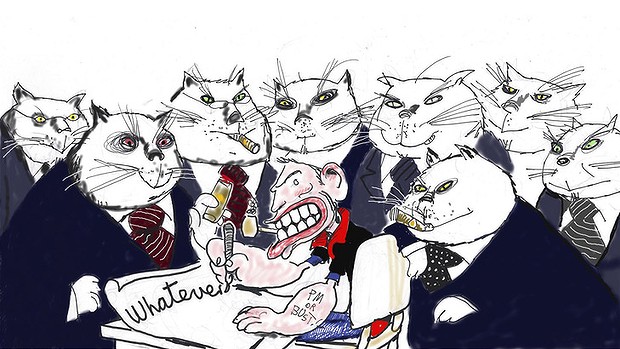
The mobilisation of business interests through the building of networks and formation of strategic alliances and coalitions is necessary in a business-managed democracy "to ensure that corporate and political elites are able to think and act with considerable unity" and to manage "elite consensus".
 .
.Business coalitions and networks work on the principle that a ‘combined voice is more powerful than one that is fragmented’. Companies that are theoretically competitors in the market, cooperate with each other to protect business interests against democratic regulations and restrictions. Individual firms network with national sectoral associations, national sectoral associations network within national peak associations such as the US Chamber of Commerce or the US Council for International Business (USCIB), and national peak associations network with international peak associations such as the ICC.
The USCIB noted that:
Leading American companies increasingly recognize that, to succeed abroad, they must join together with like-minded firms to influence laws, rules and policies that may undermine U.S. competitiveness, wherever they may be… By helping shape international regulation and expand market access for U.S. products and services, USCIB members can lower the costs of doing business abroad and enhance their long-term profitability.
An inner circle of corporate executives has facilitated the formation of many business associations and coalitions that seeks a more general political agenda than traditional trade associations; one that is not industry or region specific. The new associations present a united front for their corporate members and assert the power of large corporations in political forums. These associations cooperate with each other and ‘perform largely complementary tasks.’
They not only share members and even leaders, but associations and coalitions often join other associations and coalitions as members, or create new associations and coalitions for specific purposes. They have also created an array of front groups that achieve their political goals whilst appearing to be independent of the founding corporations or associations.
In this way a vast network of business coalitions and groups, supported by an array of well-funded think tanks and public relations firms, proliferated during the 1980s and 90s. Their purpose is not only to coordinate public relations campaigns as in earlier times but to exert collective pressure on policy makers to ensure that policies increase the power and autonomy of those corporations. And many of these coalitions are now global in their reach reflecting the transnational nature of the modern corporation, which seeks to pressure governments worldwide to implement corporate-friendly, open-access policies.
The ‘unprecedented levels of strategic alliances and global networks’ created by Transnational Corporations (TNCs) have been referred to as a new form of capitalism: ‘alliance capitalism’. In this new form of capitalism, TNCs have more in common with and show more loyalty to TNCs from around the world than with the countries they are headquartered in. Despite this shift in allegiance, national governments still go out of their way to facilitate the business activities of these TNCs and to ensure their policies do not unduly impede those activities.




 Previous
 Next
Next