 |
Business-Managed Democracy »Introduction » Inner Circle |

In his book The Inner Circle, written in the 1980s, Michael Useem claimed that whilst ‘a sense of class affinity based on company stewardship can hardly be said to be new, the strength of the bond has increased and a select circle of those in corporate power are now far more willing to work towards goals that serve all large companies.’ His study of the US and UK found that even at that time large corporations were becoming more and more interrelated through shared directors and common institutional investors.
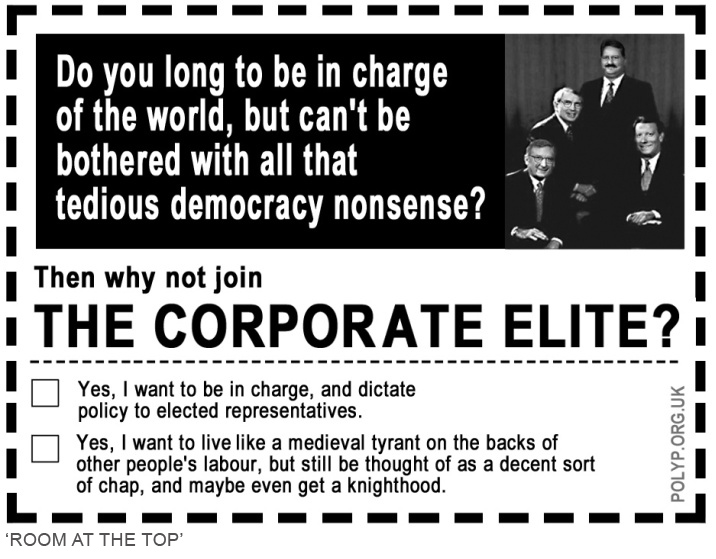 More cartoons from Polyp |
The inner circle provide the leadership for the corporate class: organizing and running the business coalitions where common goals and strategies are worked out; coordinating the public relations specialists, think tanks and media outlets that manipulate public opinion; setting the agendas for policy groups; guiding their policy recommendations onto government agendas; filling executive positions in successive government administrations and |
as government advisors; and thereby ensuring public policy outcomes that are conduciveto the business interests they favour. In this way government is intimately connected with the corporate power elite, or inner circle and this is increasing the case around the world.
The inner circle are powerful within the corporate community because of their top level management positions within large corporations, their board membership of other large corporations, and their leadership positions in business associations. Because of these multiple positions they are able to network with others in similar positions and mobilize resources and express support for political goals shared by others in the circle. Their views tend to ‘reflect the broader thinking of the business community’ rather than the concerns of an individual company.
Susan George has referred to this inner circle as the Davos Class (referring to the annual meeting of the World Economic Forum (WEF) at Davos). She describes them as "interchangeable, international, individually wealthy, nomadic, with common attributes, speaking a common language and sharing a common ideology".
The transnational nature of the modern corporation and the global reach of business coalitions has meant that the inner circle has evolved into a transnational capitalist class.




 Previous
 Next
Next