 |
Business-Managed Democracy » Education » Business Campaigns » Introduction |

Businesses believe that the poor basic skills of school graduates is costing them money. A survey of UK employers showed that they believed that millions of workers were costing their companies money because of literacy and numeracy mistakes.
Business leaders in the US see business as the “largest consumer of American education” and they “are now more prominent and more focused on specific details than ever before”.
The US-based Business Coalition for Student Achievement claims that businesses lose $2.3 billion a year because a lack of maths and reading skills are reducing their productivity.
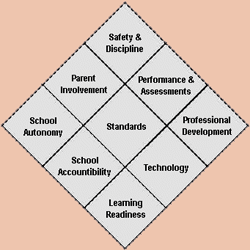 While similar business campaigns have been conducted in many countries, the influence of business in bringing about the school changes discussed in this book is most evident in the US. Their agenda for schools, spelled out in 1997 by Norman Augustine, chair and CEO of Lockheed Martin and head of the Business Roundtable’s Education Taskforce, had nine components starting with:
In 1988 Nancy Perry wrote in the business magazine Fortune, “As a major contributor of tax dollars to public education, corporate America is getting a lousy return on its investment. Not only are schools today not preparing kids for jobs, they aren’t even teaching them to read and write.”
In 1989 Fortune magazine argued: “Business needs to do a better job of telling our schools what it wants and expects from graduates” including “more emphasis on the basics – reading, writing and arithmetic” and better vocational training.
At Fortune’s second annual education conference in 1989 business leaders had decided to use their muscle to force change in schools. John Sculley, chair of Apple, pointed out: “Chief executives of global enterprises are becoming as powerful as many heads of state.” Those attending agreed that “Top managers might also play lead roles in supporting reform-minded politicians and maverick educators or in lobbying local taxpayers to join the crusade.”
A couple of years later Perry wrote: “We agree on the need for higher standards, more effective tests, a curriculum that teaches the skills industry needs, better teacher training, and more preschool education.” She quoted Robert Kennedy, CEO of Union Carbide, who exhorted business executives to make more use of their bully pulpits: “we can begin by communicating the urgency of the problem to our own employees and getting them involved.”
If you have any examples or updates you would like to contribute please email them to me and I will add them here. Please give references for where you sourced the information.




 Next
Next