 |
Business-Managed Democracy » Education » Business Campaigns » Foundations » Walton Family Foundation |

When Sam Walton, founder of the Wal-Mart empire, died in 1992 he left a fortune to his family – currently estimated at some $90 billion (“equivalent to the GDP of Singapore”) – making them the richest family in the world and putting five of them in the top ten wealthiest individuals list.
In 2012 Sam Walton's heirs received "more than $2.7 billion in dividends from their Walmart stock. That's more than the combined income of 53,000 American households earning the median income".
Wal-Mart, one of the lowest paying employers in the US, has received over a billion dollars in tax subsidies. It also campaigns for tax breaks, and against estate tax. The Waltons prefer  philanthropy to taxation because it enables them to determine how their surplus money is spent and to use if for public relations and political purposes of its own choosing. The Walton Family Foundation (WFF) “gives a staggering number of gifts, apparently in order to buy goodwill in as many communities as possible”.
Education ‘reform’ is a particularly favoured target for their PR spending and between 1998 and 2003 the Waltons donated more than $700 million to educational ‘reform’ charities. The WFF funds groups that advocate a market approach to education, including vouchers and privatisation of schools.

 Sam’s second son, John (pictured), “reputedly the world’s 11th richest man”, was the force behind the Walton’s donations to market-oriented education reforms before he died in the crash of a light plane he was flying in 2005. He saw these reforms as a way of getting poor young people off the streets: “They’re choosing the streets over a school that apparently doesn’t work for them”.
John Walton held various positions on school reform advocacy groups to achieve his ends including:
John Walton was a great champion of charter schools. Charter schools are publicly-funded schools that are run by private organizations, often companies seeking to profit from them. Rather than having to comply with the regulations that are applied to normal public schools, they are bound by a charter, which is a contract that includes the “school’s mission, academic goals and accountability procedures”. The freedom from public school regulations and bureaucracy is supposed to enable the charter schools to innovate; to introduce different curricula and teaching methods – including online classes – so as to offer choice in the type of school available to parents.
Whilst vouchers are a way of providing public funds to private schools, charter schools are privately-run schools that are government funded. As such they are a step closer to the goal of a privatised school system that many business leaders seek. The WFF has this goal and is “the single largest source of funding for the voucher and charter school movement”. Groups funded by John Walton and the Walton Family Foundation include:
Between 2000 and 2005, for example, the Foundation donated over $47 million to the Children's Educational Opportunity Foundation (CEO America), "a lobbying organization devoted to weakening the public school system in America by 'providing research and publications to school choice groups and submitting amicus curie briefs to the U.S. Supreme Court on voucher issues.'"
Other groups the Foundation funds include those that
The Foundation also donates money to think tanks such as the American Enterprise Institute, the Cato Institute, the Heritage Foundation, the Hudson Institute and the Heartland Institute.
Although they are supposed to promote competition between public schools as a way for the market to provide incentives for reform, Walton family money enables charter schools to be better resourced (per student) than neighbouring public schools, ensuring that they have an advantage in the competition. They gave $3 million to KIPP charter schools in 2003 alone “and millions more to other schools using the KIPP curriculum”.
The Walton Family Foundation had helped to establish over 750 charter schools by 2008:
The foundation has supplied critical funding to open individual charter schools, helped pay for the creation and expansion of charter networks, supported knowledge collection and research on school choice, and backed a wide range of state and national organizations that provide support and advocacy for charter schools and voucher programs.
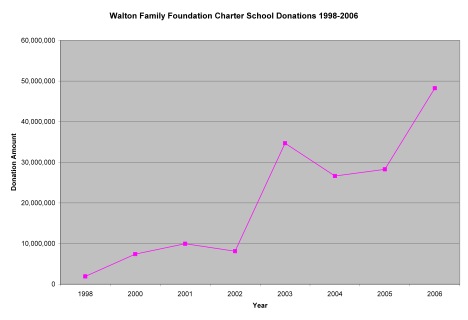
The Foundation funds charter schools in 30 urban school districts and in Arkansas. It also supports charter school groups that develop "state and national associations that serve, protect and cultivate the public charter school movement". Donations to charter schools by the Foundation between 1998 and 2006 are shown below, reaching almost $50 million in 2006 and in 2007 $60 million in donations and $23 million in loans.
If you have any examples or updates you would like to contribute please email them to me and I will add them here. Please give references for where you sourced the information.




 Previous
 Next
Next