 |
Business-Managed Democracy » Inner Circle » Interlocking Directorates |

Michael Useems' study of the US and UK found that even in the early 1980s large corporations were becoming more and more interrelated through shared directors and common institutional investors.

Various studies have shown that interlocking directorates have grown even more in the ensuing decades and have become more global. What is more the size of corporate boards has decreased whilst the proportion of outsiders on each board has increased with CEOs and executives from other companies therefore dominating the composition of many boards.
 A team of Swiss systems theorists, utilising a database of 37 million companies and investors worldwide, studied the share ownerships linking over 43,000 transnational coporations. "Then they constructed a model of which companies controlled others through shareholding networks, coupled with each company's operating revenues, to map the structure of economic power." They found that a core 1318 companies (shown in red on the diagram to the left), representing 20 percent of global operating revenues, "appeared to collectively own through their shares the majority of the world's large blue chip and manufacturing firms - the "real" economy - representing a further 60 per cent of global revenues".
When the team further untangled the web of ownership, it found much of it tracked back to a "super-entity" of 147 even more tightly knit companies - all of their ownership was held by other members of the super-entity - that controlled 40 per cent of the total wealth in the network. "In effect, less than 1 per cent of the companies were able to control 40 per cent of the entire network," says Glattfelder. Most were financial institutions. The top 20 included Barclays Bank, JPMorgan Chase & Co, and The Goldman Sachs Group.
In the US corporations with the most extensive interlocking board connections – American Express, Sara Lee, Chase Manhattan Bank, General Motors, Procter and Gamble – tend to play a central role in business networks. Their directors are 90-95 percent male, 95 percent white, usually business executives, bankers or corporate lawyers, and tend to vote Republican. The few business leaders who don’t fit this profile, nevertheless, adhere to corporate values. These directors, along with the leaders of supporting think tanks and policy groups, constitute a corporate class with common interests in fostering a pro-business political climate that has minimal scope for democratic intervention.
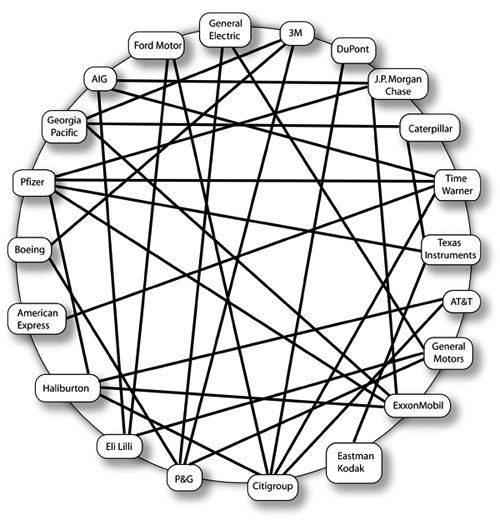
Some interlocking directorates in key corporations mentioned in this website are shown in figure below. Corporations that are joined by a line have at least one shared person on their board of directors. So for example, AIG has directors that are also directors of JP Morgan, Time Warner and Eli Lilli.




 Previous
 Next
Next