 |
Business-Managed Democracy »Environment » Global Warming » Vested Interests |

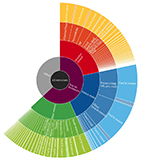
50 leading investor-owned, 31 state-owned, and 9 nation-state producers of oil, natural gas, coal, and cement have contributed "63 % of cumulative worldwide emissions of industrial CO2 and methane between 1751 and 2010". The top twelve were:
In the lead up to the 1997 UN conference on climate change in Kyoto, coal and oil industry groups spent millions of dollars on advertising, gave speeches to the Senate and the President, and argued that the proposed treatey would lower the US standard of living. They were joined in their campaign by the automobile industry, chemical companies, farming groups and others.
Business groups claimed "that the science was unproven, reductions could be economically ruinous, trade competitiveness could be damaged, fuel costs could skyrocket and countless jobs would be eliminated." At the conference business representatives gave speeches in plenary sessions and once the Kyoto Protocol had been announced these industry groups denounced it.
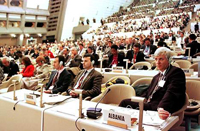 Throughout 1998 these same vested interests lobbied against US ratification of the Kyoto Protocol. The Republican-chaired House Subcommittee on National Economic Growth, Natural Resources, and Regulatory Affairs held a series of hearings entitled “Kyoto Protocol: Is the Clinton-Gore Administration Selling Out Americans?” to which many business people testified, including executives from the American Petroleum Institute, the Ford Motor Company, The American Coal Company and the National Mining Association.
Efforts were also made to prevent the Clinton administration from implementing measures to achieve Kyoto targets without Senate ratification of the agreement. Republican Joe Knollenberg managed to get a provision included in the 1999 appropriations for the Environmental Protection Agency which seeks to stop the EPA from taking actions that are aimed at meeting Kyoto targets. Republicans then sought to extend the legislation to ensure that the whole government is prevented from regulating carbon dioxide emissions.

Subsequent UN climate change conferences saw an exponential growth in the presence of business groups. At these conferences, non-government groups are able to:
participate in the negotiating process in a number of ways, such as making formal interventions during negotiating sessions, attending informal contact group meetings and discussing the issues with national negotiators. They also conduct special 'side events', to provide detailed presentations and discussions on specific topics, and set up exhibits, where they distribute reports, analyses and commentary papers on negotiating issues. These 'side events' have greatly expanded in number, as well as in substantive range and content.
These side events attract media attention, and media reports are read by negotiators via newspaper articles posted and distributed at the conference and delivered directly to government officials.
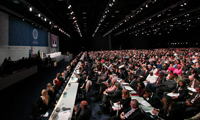 Business lobbyists were again present in force at the 2009 UN climate change conference in Copenhagen. As well as trying to prevent specific targets for greenhouse gas reductions being agreed to at the conference, they sought to ensure that a wide range of offsets would be available to polluting companies via carbon trading markets, and that funding would be made available for dubious technologies such as carbon capture and storage (CCS), nuclear power and biofuels.
Business lobby groups included:
In addition there were a number of specialist lobby groups.
In the lead up to the 1997 international Kyoto conference on global warming the fossil fuel industries stepped up their campaign to prevent a treaty being signed that involved national greenhouse gas reduction targets. A US consortium of 20 organisations  launched an anti-climate treaty campaign in September 1997. These industry groups representing oil, coal and other fossil fuel interests spent an estimated $US13 million on television, newspaper and radio advertising in the three months leading up to the Kyoto conference to promote public opposition to the treaty. Speaking at a news conference on this campaign, the President of the National Association of Manufacturers, Jerry Jasinowski (pictured), argued that the treaty would mean energy prices would go up, jobs would be moved to developing countries, and businesses, farmers and consumers would suffer.
Other adverstising campaigns against action to prevent global warming have been run by




 Previous
 Next
Next