
In 1997 BP left the Global Climate Coalition. CEO John Browne argued that it was time to act to prevent greenhouse warming rather than continue to debate whether it would occur or not, becoming the first multinational, apart from reinsurance companies to do so. For his stance on  climate change, Browne and BP earned the reputation of being environmentally progressive in an industry that largely refused to accept that global warming was likely to occur.
In 1998 BP announced a target of 10% reduction in its own greenhouse emissions from 1990 levels by 2010 by applying new technologies, using energy more efficiently and eliminating flaring. BP does not, however, count the emissions from the use of its products (oil and gas) in this target, which is of course by far the major contribution to global warming that BP is responsible for.
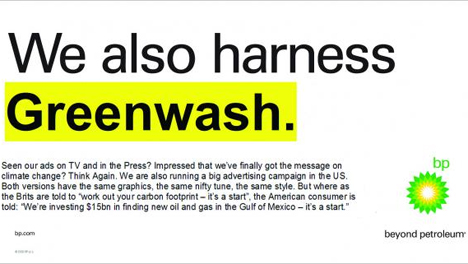
Spoof advertisement from London Rising Tide

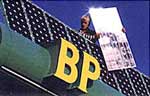 In March 1999 BP launched its 'Plug in the Sun' program based on its investment in solar energy and the installation of solar panels on 200 petrol stations around the world. In its advertisements it said, 'We can fill you up by sunshine' as if this would distract people from noticing it was still petrol they were putting in their cars.
For this program it was awarded a Greenwash award by Corporate Watch which stated that 'the company hopes that by spending just .01% of its portfolio on solar as it explores for more oil and sells more gasoline, it can convince itself and others of its own slogan: BP knows, BP cares, BP is our leader.' Corporate Watch noted that even if this level of investment was increased ten times, as promised by BP, it would still be less than 2 percent of what BP spends on oil. BP's investment of $45 million in purchasing the solar firm Solarex needs to be compared to $400 million just for Stamp duty on its purchase of the oil company ARCO and $100 million for lawyers and advisers fees for the purchase. It was also less than a quarter of what BP spent on rebranding itself as bp, beyond petroleum.
In a similar satiric vein, Greenpeace USA gave BP CEO, John Browne, an award for 'Best Impression of an Environmentalist' for his 'portrayal of BP Amoco as a leader in solar energy' while running a company 'with far greater investment in dirty fossil fuels that are causing global warming.' Greenpeace noted that BP planned to spend $5 billion over the next five years on exploring for and producing oil in Alaska even though the planet could 'not afford to burn 75% of the fossil fuels we've already discovered, if we are to avert catastrophic global warming'. It noted that for every $16 that BP was spending on solar energy in 1998 it spent $10,000 on oil exploration and development.
BP has recommended that international agreements aim to stabilise carbon dioxide at concentrations of 500-550 ppm. This compares to a safe limit of 350 ppm suggested by leading scientists.
More recently BP won the Greenpeace 2008 Emerald Paintbrush' award for worst greenwash for 'its multimillion dollar advertising campaign announcing its commitment to alternative energy sources. Slogans such as "from the earth to the sun, and everything in between” and “the best way out of the energy fix is an energy mix"'. In reality solar power made up just 1.39 per cent of BPs investment in 2008 'and wind a paltry 2.79 per cent'.
 BP was also a nominee for the 2009 Climate Greenwash Awards "for their enthusiastic lobbying for carbon trading as a false solution to climate change, for cutting their investment in renewable energy, for massive investment in fossil fuels and for, inspite of all this, claiming to be green."
In 2008 BP withdrew from its wind power investments in Britain and in that same year invested in the extraction of oil from Canadian tar sands, which it claims to be a 'green' investment even though it is far more greenhouse gas intensive that normal oil. BP no longer promotes itself as going beyond petroleum but rather emphasises the need for diversity of energy sources. Its billboards proclaim: "We can't put all our energy in one barrel" and show images of plants, wind turbines and the sun.
However BP remains as committed to ever increasing production and usage of oil and gas as in 1997 when Browne argued that in the future renewable energy would make up a greater share of the market in future but would not be 'instead of oil and gas; it is additional'. He told The Oil Daily that 'The world needs oil and gas in growing volumes. But the people of the world have to be convinced that their needs can be met without destructive consequences.'
Although BP claimed to be spending $1.5 billion each year on 'alternative' energy, it includes natural gas in that category, as well as its emissions trading business. In contrast it is spending $21 billion each year on oil and coal. Moreover its profits for three months in 2008 were $10 billion.
In 2009 BP Alternative Energy was downgraded from being a separate business and its budget slashed. In 2011 BP Solar was closed down. In 2013 it tried to sell of its US wind farms but could not find a buyer. It has stopped its research into carbon capture and storage. By 2015 BP had cancelled much of its renewable energy program. A spokesman for BP said that it was still spending $132 million a year on "a low-carbon transition".
But he accepted that the company had retreated from renewable energy which had once had its own separate headquarters and chief executive, saying it was up to others to do that work..."It is clear that it is the role of governments and regulators to set the boundary conditions for the policy framework which is needed to bring about this transition. BP's role is to develop its business within that framework," the spokesman added.
BP has also been criticised not only for the Deepwater Horizon oil spill in the Gulf of Mexico in 2010 but also for its continuing acquisition of oil reserves and extraction of oil from tar sands.
In Australia, BP joined with other industry leaders, including Rio Tinto and Alcoa, to lobby the government not to ratify the Kyoto Protocol unless the US does so first. The industry leaders also urged the government to guarantee that no jobs will be lost to greenhouse reduction measures (interesting given the massive job losses that resulted from BP's acquisitions) and to seek the most 'liberal' rules for meeting targets which include the use of carbon sinks. BP argued that Australia should not introduce an emissions trading scheme before an international one was introduced.
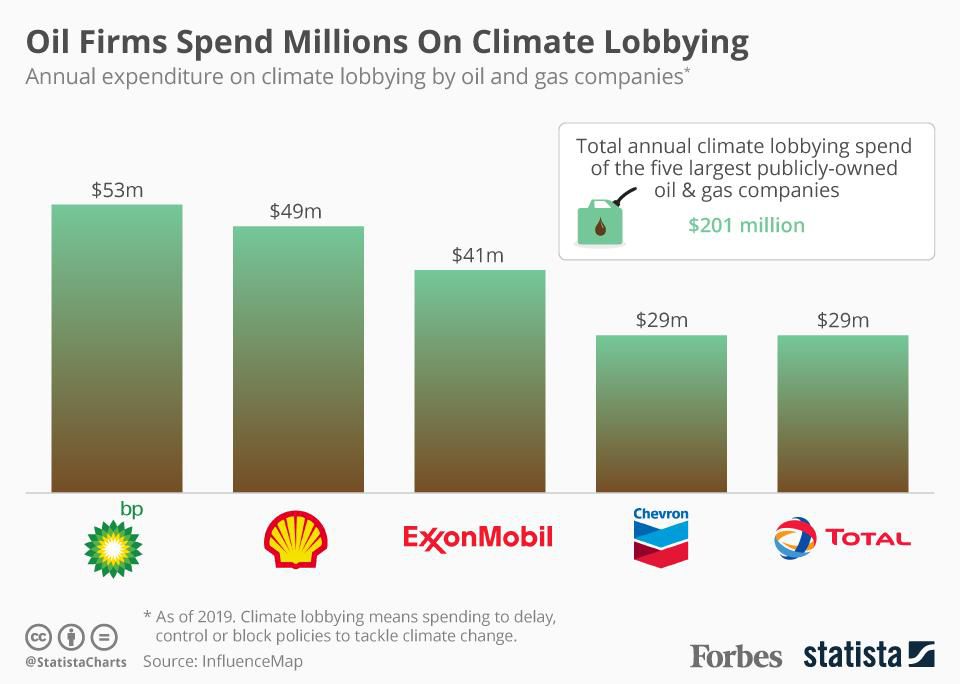
In the US BP lobbied against 2005 efforts to introduce mandatory reductions in greenhouse gas meissions as part of a national energy bill. By 2019, BP's annual expenditure on lobbying to prevent policies to tackle climate change was greater than the other major oil companies (see graphic below).
Browne also opposed to an energy tax. He also opposed to any dramatic or fast action to reduce emissions. It is better, he argued, to take a step-by-step approach that balances the 'needs of development and environmental protection'. He argues the timetable of change should be 'compatible with capital stock turnover in the energy sector and the wider economy' and constrained by 'the magnitude and age of existing energy infrastructure.'
BP continues its membership of the American Petroleum Institute (API), despite API's anti-global warming regulation activities.





 Previous
 Next
Next