 |
Business-Managed Democracy » Education » Privatising Schools » Charter Schools in the US » Performance |

In general the teaching standard in charter schools varies enormously. However, studies have failed to show that, on average, charter schools perform significantly better than public schools with similar demographics. In fact some show they perform worse. Researchers have noted that whilst a few charter schools use their freedom from regulation to innovate and hire talented but uncertified teachers, others use it to cut costs and run schools badly: ‘If bonanzas are realized in some places, they are apparently offset by catastrophes in others.’
An Education Department analysis also found that the longer a charter school had been operating, the more test scores declined. Another study by researchers at Western Michigan University found that states where charter schools are mainly run for profit have worse learning outcomes.
| Year | Researchers | Scope | Comparison with other Public Schools |
|---|---|---|---|
| 2003 | 
Reference: Cited in ‘Charter Schools’, EPE Research Center, 10 September 2004. Rand Corporation for state government |
California | No significant difference |
| 2003 |
Reference: National Assessment of Educational Progress (NAEP), ‘America’s Charter Schools: Results from the NAEP 2003 Pilot Study’, US Department of Education 2003, p. 1. National Assessment of Educational Progress (NAEP) |
fourth graders | No measurable difference |
| 2004 |
Reference: Cited in Diana Jean Schemo, ‘A Second Report Shows Charter School Students Not Performing as Well as Other Students’, New York Times, 16 December 2004. Education Department |
fourth graders | Performance worse |
| 2005 |
Reference: Martin Carnoy et al., ‘The Charter School Dust-Up: Examining the Evidence on Enrollment and Achievement’, Washington, DC, Economic Policy Institute 2005, p. 2. Economic Policy Institute |
eleven states and DC | No difference or performance worse |
| 2006 |
Reference: Cited in ‘Reining in Charter Schools’, New York Times, 10 May, 2006. Western Michigan University researchers |
Michigan, Ohio | Performance worse |
| 2006 |
Reference: ‘A Closer Look at Charter Schools Using Hierarchical Linear Modeling’, National Center for Education Statistics, US Dept. of Education, August 2006. National Center for Educational Statistics |
National | Performance worse |
| 2007 |
Reference: Gary Miron et al., ‘Evaluating the Impact of Charter Schools on Student Achievement: A Longitudinal Look at the Great Lakes States’, Education Policy Research Unit (EPRU), Arizona State University and Education and the Public Interest Center (EPIC), University of Colorado at Boulder, June 2007. Education Policy Research Unit (EPRU), Arizona State University |
Six Great Lake states | Performance worse |
| 2009 |
Reference: 'New Stanford Report Finds Serious Quality Challenge in National Charter School Sector', Center for Research on Education Outcomes (CREDO), Stanford University, 15 June 2009. CREDO National Charter School Study |
National | Performance worse |
| 2011 |
Reference: B. D. Baker & R. Ferris, 'Adding Up the Spending: Fiscal Disparities and Philanthropy among New York City Charter Schools'. Boulder, CO: National Education Policy Center, 2011. National Education Policy Center |
New York | No significant difference, fewer English learners |
The 2009 CREDO study by Stanford University, which examined 2400 charter schools in 16 states found wide variation in charter school performance but concluded that on the whole, "students in charter schools not faring as well as students in traditional public schools". 17% of charter schools had significantly better academic gains, 37% had significantly worse gains and 46% were not significantly different to traditional public schools.
However as some of the worst performing charter schools have been closed down the average performance of charters schools in the US has improved over the years, at least according to test scores. An updated 2013 CREDO study of charter schools in 27 states by Stanford University researchers found:
In reading, charter school students on average have significantly stronger growth than [Traditional Public School] TPS students in 16 of the 27 states evaluated. Reading growth was weaker for charter students in eight states and similar in three states. In math, 12 state charter sectors had stronger growth than TPS, 13 states had weaker growth, and two had growth that was similar to TPS.
Given the extra funds that many charter schools receive and the extra time that students spend being drilled to pass standardised tests at charter schools, this result is not an overwhelming endorsement of charter schools. And what about all those students who suffered in disasterous charter schools for years before they were finally closed down?
In Missouri, most charters schools do not meeting state proficiency standards and the state does not have the power to close even the worst performing of them.
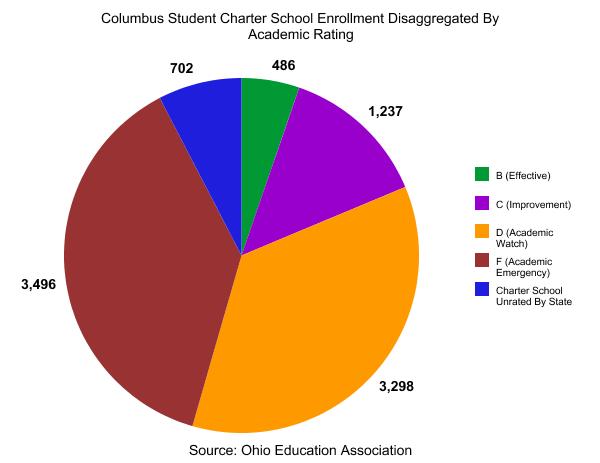 |
"Of the 8,518 Columbus students attending a charter school that had received a state rating for the 2007-2008 academic year, over 79% attended a school ranked D or F." This compares with 34 % of students in the Columbus City Schools (CCS) system. |

Despite the dismal record of charter schools’ performance President Bush tried to facilitate their expansion with the reauthorisation of the NCLB Act by enabling school districts to ignore state caps on the number of charter schools if schools fail to reach Annual Yearly Progress for five years in a row. The Education Department also proposed to offer rural areas online charter schools.
President Barack Obama is also a supporter of charter schools: ‘I doubled the number of charter schools in Illinois despite some reservations from teachers unions. I think it’s important to foster competition inside the public schools.’ He is promoting charter schools with the Race to the Top Fund.
If you have any examples or updates you would like to contribute please email them to me and I will add them here. Please give references for where you sourced the information.




 Previous
 Next
Next