 |
Business-Managed Democracy » Culture » Consumerism » Advertising to Children » Television Advertising |

 ; Newton N. Minow and Craig L. LaMay, Abandoned in the Wasteland: Children, Television, and the First Amendment, New York, Hill and Wang, 1995, p18; Richard Zoglin, ‘Is TV Ruining Our Children?’ Time, 15 October, 1990.
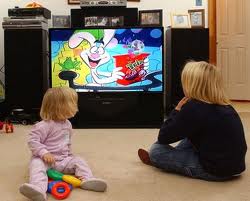 Television is an ideal way for advertisers to reach children as it is so omnipresent in homes around the world. In more than a third of the homes of American preschool children the television is on most of the time, whether or not anyone is watching. By the time they get to first grade American children will have “spent the equivalent of three school years in the tutelage of the family television set” and by the time they finish high school they will have spent more time watching television than they spent in class for their entire schooling.
In the US:
.
; Susan Gregory Thomas, Buy, Buy Baby: How Consumer Culture Manipulates Parents and Harms Young Minds, Boston, Houghton Mifflin, 2007, p. 9.
.
 In Australia:
.
In the UK:
.





 Previous
 Next
Next