 |
Business-Managed Democracy » Education » Standardised Curricula » Educational Paradigms |
The demands by business coalitions for rigorous academic standards for all students and regimes of testing is in fact a call for a return to the traditional paradigm of education in response to the growth of a progressive paradigm. 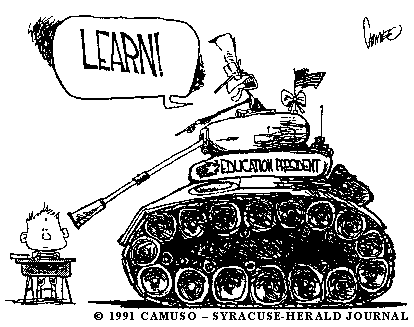
Progressive Paradigm Traditional Paradigm Table: Paradigms

The progressive paradigm of education which arose early in the 20th century and gained dominance in the 1950s stressed the development of individual intellectual potential, creative self-expression, analytical thought, and the development of responsible citizens, reflective and critical thinkers. It placed the development of the child at the centre of education with interdisciplinary topic work, an integrated school day, curriculum content relevant to situation and student backgrounds, a cooperative work environment and teachers as facilitators rather than disciplinarians or authority figures.

For those who believe in the progressive paradigm of education, education is not simply a matter of acquiring a body of knowledge but rather about giving people the types of “dispositions and orientations” that will enable them to solve problems, learn autonomously in new situations, deal wisely with change and diversity, and be “flexible and creative”. The traditional paradigm sought to fit the child to the existing social order, whereas the progressive paradigm sought to give students the capacity to transform it.

The progressive paradigm was in contrast to the traditional paradigm of education (see table below) whereby education was supposed to develop character and virtue in the child, through discipline and the transmission of a common cultural heritage. During the nineteenth century educators sought to educate children “by two disciplines – that of the will in correct habits, and by that of the intellect in the correct view of the world”. The purpose of rigour in school subjects was to provide mental training and discipline to ensure the prosperity of society.
The Australian Council of Deans of Education describes the traditional paradigm, which they refer to as the “old basics”:
The process was learning by rote and knowing the ‘correct answers’. ‘Discipline’ was demonstrated in tests as the successful acquisition of received facts and the regurgitation of rigidly defined truths… Actually, the very idea of the basics indicated something about the nature of knowledge: it was a kind of shopping list of things-to-be-known—through drilling the ‘times tables’, memorising spelling lists, learning the parts of speech and correct grammar.
| Progressive | Traditional |
|---|---|
| Integrated subject matter | Separate subject matter |
| Teacher as guide to educational experiences | Teacher as distributor of knowledge |
| Active pupil role | Passive pupil role |
| Pupil participation in curriculum planning | Pupils have no say in curriculum planning |
| Learning predominantly by discovery techniques | Accent on memory, practice and rote |
| External rewards and punishments not necessary | External rewards and punishments used |
| Not too concerned with conventional academic standards | Concerned with academic standards |
| Little testing | Regular testing |
| Accent on co-operation and group work | Accent on competition |
| Teaching not confined to classroom | Teaching largely confined to classroom |
| Emphasis on team teaching | Emphasis on individual teaching |
| Open plan layout | Closed classroom layout |
| Accent on creative expression | Little emphasis on creative expression |
If you have any examples or updates you would like to contribute please email them to me and I will add them here. Please give references for where you sourced the information.




 Previous
 Next
Next