 |
Business-Managed Democracy » Education » Standardised Curricula » Paradigms » Back-to-Basics |

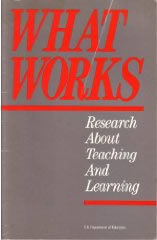 In 1986 the US Department of Education published a booklet on What Works in schools, supposedly based on extensive research. Its prescription for schools included enforcement of discipline, memorization (of spelling, literary passages and historical dates), moral awareness, academic rigour, good character, continuous assessment and positive work attitudes. It stated:
"Teachers can encourage students to develop memory skills by teaching highly structured and carefully sequenced lessons, with frequent reinforcement for correct answers. Young students, slow students, and students who lack background knowledge can benefit from such instruction.
In addition, teachers can teach ‘mnemonics,’ that is devices and techniques for improving memory."
What Works was part of the push to return to the traditional paradigm, or back-to-basics, as it has been referred to. According to Ben Brodinsky, in a 1977 issue of Phi Delta Kappan, the characteristics of back-to-basics were:

If you have any examples or updates you would like to contribute please email them to me and I will add them here. Please give references for where you sourced the information.




 Previous
 Next
Next