
In several countries today children are tested from an early age, and frequently. These standardised tests are sometimes the sole basis for judging the quality of teaching and schools. Whilst compulsory standardised tests for primary school children tend to be confined to English speaking countries, Eastern European countries are being required to introduce external tests in return for aid.
| UK Australia Canada USA | 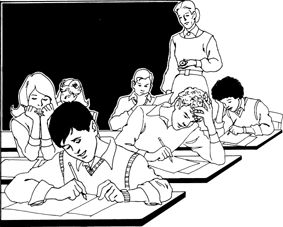 |
 Accountability was one of the ‘five great themes’ of the Conservative government in the UK during the 1980s. The 1988 Education Reform Bill established “a national curriculum with specified core and foundation subjects” for all students attending government schools. The national school curriculum details what students should learn in each grade in terms of knowledge, skills and understanding.
The Blair Labour government in the UK subsequently increased the emphasis on standard national curricula, testing and accountability.
Today the “external testing regime imposed on English schools is the most extensive, and many would say, oppressive, in the world.” Children are given standardised tests at ages 5 (entry to primary school), 7, 11 and 14 as well as sitting school leaving exams and pre-university exams. By the time they leave school at 16, students will have sat 70 public tests and exams.

By the 1990s standardised testing had been introduced in all Australian states, and by 2008 they were a nationwide requirement, starting in year 3 in primary school, and then in years 5, 7 and 9 for literacy and numeracy benchmarks (minimum acceptable standards). Subject standards are set at the state level. These tend to be outcome-based, that is prescribing levels of performance and knowledge to be acquired at each grade. Results are reported to ensure accountability.
Australia is introducing a national curriculum beginning with English, Maths, Science and History. (see Australian Curriculum, Assessment and Reporting Authority (ACARA)).
Alberta lead the way with “an extensive program” of standardised testing that was expanded during the 1980s.
In Ontario, the New Democratic Party (NDP) government formed an Educational Quality and Accountability Office (EQAO) in 1995 and the Progressive Conservative government introduced a system of standardised testing with the Education Improvement Act in 1996 which today involves testing of children in Grades 3 and 6 for reading writing and mathematics, 9 for mathematics and 10 for reading and writing literacy.
Curricula standards are set at the state level and “children are tested to an extent that is unprecedented in our history”.
In New York for example, “ a student in a college bound, academic track will have taken twenty-nine state-mandated tests between kindergarten and twelfth grades. Local districts may impose many more assessments.”
In 2001 the No Child Left Behind (NCLB) Act was passed in the US requiring states to set standards, assessments and ensure accountability. It required that standards be set for mathematics, reading and science. Students have to be tested every year in grades 3 to 8 and schools have to show improvement in student test scores over time. In New York, students are tested five times a year in elementary schools, four times a year in high schools.
The Bill and Melinda Gates Foundation financed and coordinated a campaign to introduce national standards, Common Core, and some 45 states have adopted them.
If you have any examples or updates you would like to contribute please email them to me and I will add them here. Please give references for where you sourced the information.





 Previous
 Next
Next