Business-Managed Government
Service Quality and Reliability
Water Quality Electricity Reliability
Service and reliability have also declined after privatisation and deregulation. This reduction in service provision tends to affect ordinary householders far more adversely than large industrial enterprises, which often have back up power sources and benefit from cut-rate prices.
The supposed efficiency gains to be made by private, competitive companies, have too often been made through short term cost savings. These include cuts to safety, use of shoddy materials, deferred maintenance, smaller training and research budgets and downsizing workforces. Old equipment is not regularly serviced nor replaced in advance of likely failure, pipes leak, and treatment plants become less effective. As a result there are more accidents and equipment breakdowns.
For electricity networks this means an increase in equipment-related blackouts as well as blackouts related to network congestion because planning and responsibility for network maintenance and development is not a market priority. For water and sewerage it means interruptions to water supply, leaking pipes, sewer overflows and water contamination.
In the public service it was not uncommon for employees to have a strong public service ethos, particularly in the utilities where they "traditionally took pride in their safety record, in the quality and impartiality of advice offered to consumers, and in a number of socially responsible activities such as free servicing of old age pensioners' appliances." This was lost as employees were forced to take a more commercial view of their work.
In the case of services such as water and electricity the conflict between commercial motives and environmental protection are also apparent as increased usage earns higher profits for private corporations but harms the environment.
Water Quality
Water quality has also declined in some parts of the world after privatisation and pollution incidents have often increased as well.
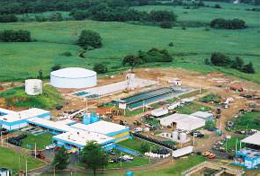
For example, Compañia de Aguas, a subsidiary of Vivendi (now Veolia), was fined $6.2 million for environmental violations in Puerto Rico that occurred between 1995 and 2000. A Puerto Rican government report found in 1999 that it had not maintained the aqueducts and sewers adequately. Customers were without water for months at a time but nevertheless got charged for the water.
In the Argentinian city of Tucumán, city officials took action against Vivendi for poor performance because their water was often brown. In response Vivendi unsuccessfully sued the Government of Argentina in a World Bank court for violating its contract by not preventing the action being taken. In Buenos Aires, Suez raised rates by 20% but failed to fix the sewerage system as it had been contracted to do and 95% of the sewage of the city of 10 million people went into the river.
There is little incentive to spend money on the sewage end of the water cycle. In the UK, the private water companies are among the most polluting companies in the country and although they have been successfully prosecuted many times, the fines do not deter their polluting behaviour.
Trailor for the Film, ‘H20 up for Sale’, 2006
In Atlanta, Georgia city authorities terminated a 20 year contract with Suez owned United Water in 2003 (after only four years) because of problems in service quality including failure to properly maintain the system. Similarly, in Camden, New Jersey a 20 year contract with United Water was terminated halfway through in 2009 because of poor maintenance, loss of water through leaks and overflows and unapproved payments. United Water's contract in Milwaukee, Wisconsin was not renewed in 2008 because of problems such as sewage overflows and in Gloucester, Massachusetts, its sewerage contract was terminated in 2009 due to bacterial contamination of drinking water. Its sewerage contract in Gary, Indiana was also cancelled in 2010 after a series of broken sewer lines led to over 80 cave-ins between 2003 and 2007 and violations, by United Water, of dicharge limits on more than 80 ocasions between 2005 and 2007. However the cited reason for contract cancellation was that thelocal authorities thought they could do the job for half the cost.
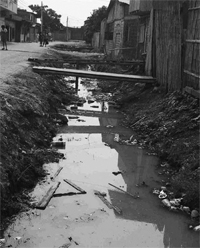
In Guayaquil, Ecuador, Bechtel subsidiary, Interagua, put 95% of the sewage, untreated, into the river which caused many health problems. The contamination of drinking water caused 150 children to get hepatitis A in 2005. In addition water supply was repeatedly shut down for up to 36 hours.

Examples of Suez/United Water's Operations in the US
| Location | System |
Poor Upkeep |
Inadequate Service, Staffing |
Water Quality Violations |
High Costs |
|---|---|---|---|---|---|
| Atlanta, Georgia | Drinking Water | X |
X |
||
| Camden, New Jersey | Drinking Water, Sewer | X |
X |
X |
|
| Fairfield-Suisun Sewer District, California |
Sewer | X |
X |
||
| Gary, Indiana | Sewer | X |
X |
X |
X |
| Gloucester, Massachusetts |
Drinking Water, Sewer | X |
X |
X |
|
| Houston, Texas | Drinking Water | X |
|||
| Laredo, Texas | Drinking Water | X |
|||
| Milwaukee, Wisconsin |
Sewer | X |
X |
X |
|
| North Brunswick, New Jersey |
Drinking Water, Sewer | X |
Veolia
In 2003 Veolia dominated the US market with 26 water contracts and 42 sewerage contracts. However its performance was no better than United Water's. Its contract was terminated in Angleton, Texas its contract was terminated for non-performance nd it was taken to court for not having adequate staff and other breaches of contract. In Lynn, Massachusets its wastewater overflow plant contract was terminated. Its misdemeanours there included cutting costs by inadequately treating wastewater with chemicals.
In Puerto Rico, a Vivendi (now Veolia) subsidiary was found, by the Office of the Comptroller to have been guilty of poor maintenace and repair and deficient operation of aqueducts and sewers causing some rate-payers to go without water.

Electricity Reliability
Service and reliability have declined in privatised electricity systems because the service obligations of government-owned electricity companies are replaced by short-term commercial goals.
Black-outs and price spikes also increase as a result of lower reserve levels of generation capacity brought about by the perverse incentives of the market system which give greater profits to private generating companies in times of electricity shortages. This not only discourages investment in new generation capacity but encourages withholding of electricity in times of peak demand to send prices higher.
Electricity markets that rely on private investment in generation tend to produce a pendulum effect between too much power and too little, with private companies reluctant to invest in new capacity until a prolonged period of shortage pushes average prices up. Then they all rush to build new capacity, usually peak plants, creating a glut for a period when wholesale prices drop (though not necessarily retail prices if the market is vertically integrated). This working of the market creates an unnecessary burden for consumers for long periods of time when prices are high and supply unreliable.
Since deregulation in the US has removed the service obligations from private companies they are able to increase their profits by cutting maintenance schedules and staff and neglecting the upgrading of infrastructure. This is particularly the case for privately-owned transmission companies because it can be cheaper, in the short-term, to replace equipment after it fails than preempting that failure with a timely replacement. If such failures result in blackouts then others bear most of the costs. It might even prompt a government to pay millions of dollars in subsidies.
Consequently massive reduction of the utility workforce in the US with 150,000 people losing their jobs, including those who were responsible for safety and reliability of electricity supplies, as private deregulated utilities shed staff so as to cut costs. It is estimated by the Utility Workers Union of America (UWUA) and the US Department of Energy’s Energy Information Administration (DOE EIA) that utilities now employ less than two thirds of the workers they did in the early 1990s. The UWUA claims that cost-cutting has led to fewer inspections, deferral of repairs, and less worker training, all of which threaten worker and public safety as well as system reliability.
The widespread electricity blackouts in the north-eastern states of the US and Canada was one of the more spectacular consequences of a deregulatory process that aimed at removing government controls and letting the market decide. In a deregulated market no one is responsible for planning or ensuring adequate generation or transmission facilities into the future. This does not matter with some commodities, but it can lead to crises in the case of electricity supply because electricity is so essential to human welfare and economic activity.
A lack of maintenance contributed to the blackouts in New York City as it did in Chicago, Long Island, 62 New Jersey, New England, and Texas. For example, a series of fires in electrical transformers caused power blackouts in New York City during the summer of 2002. These were the result of aging equipment unable to keep up with demand because there was no incentive in the deregulated system to upgrade equipment and no-one held responsible when it fails.
Australian Examples
In Victoria, Australia, the frequency of blackouts increased by 32% between privatisation in 1995 and 1999. In 1997 a Coopers and Lybrand survey found 35 percent of the privatised companies believed “previously experienced reliability levels would/may not be provided by the market”. The Victorian Government could not intervene to prevent blackouts, it argued, as that would result in “an unacceptable distortion of the market”. The companies took a cavalier approach to the difficulties blackouts caused consumers, one of them even going so far as to argue that “Customers need to experience some disruptions” so as to appropriately value their electricity supply.
In South Australia fuses and transformers failed across the state and transmission across high-voltage lines was deliberately cut off to avoid potential fires on very hot days. There were 500 outages in January 2001 alone. SA Independent Industry Regulator, Lew Owens, claimed that the network was outdated and neglected and unions claimed that the 900 workers employed to check and repair powerlines in 1991 had been reduced to about 300 after privatisation, whilst maintenance crews were reduced from 270 to 90. According to SA auditor-general Ken McPherson the leasing arrangements did not require private companies leasing generating facilities to upgrade or even maintain those facilities. And certainly the market provided no incentive to do so.
Before privatisation the Electricity Trust of South Australia (ETSA) had maintenance teams which monitored transformers and replaced them before they failed, thus ensuring minimal interruption to the electrical supply. One theory for the increased failure of transformers after privatisation is that these teams were discontinued and instead transformers were left in place till they failed, giving them a slightly longer life of a year or two. This would have saved money at the expense of reliability. Also the lives of transformers can be increased by downrating them, so that they do not run at full load and do not get so hot. This could be done by installing lower-rated fuses in the transformer boxes on suburban power poles. These fuses would blow before reaching full load. The power supply would be cut but the fuse could be replaced rather than the transformer a much cheaper option at $10 per fuse.
Indeed, many of the interruptions to power supply in South Australia in 2000-01 were being caused by transformer fuses blowing. In just one night in February 2001 fuses blew on 45 transformers, cutting electricity to 750 homes which wasn't restored for up to two hours. In the previous summer 270 fuses went in a couple of months, cutting power to 3000 homes. ETSA Utilities responded by blaming air conditioners for placing too big a load on the fuses. Unions claimed that the 900 workers formerly employed to check and repair power lines had been reduced to about 300, while maintenance crews had been cut from 270 to 90.
The Australian Retailers Association executive director, Stirling Griff, argued that shop-owners in South Australia, after privatisation, were having to shut up shop, losing substantial amounts in sales, because of power failures. Hospitals considered the possibility of switching to generator power during peak periods to be sure of a continuous electricity supply. There was “a mini-boom in generator sales to guarantee power supplies” in readiness for the following summer.
| Employment | Public Opposition


