 |
Business-Managed Democracy » Education » Sponsored Materials » Environment » Chemical Industry |
The chemical industry has been at the forefront of designing school and classroom materials, particularly in the area of science. These materials use the following strategies.

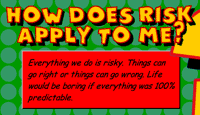 In the UK the Chemical Industry Education Centre (CIEC) provides classrooms resources and several dedicated ‘educational’ websites including “two sites looking at the environmesnt, and what industry is doing to make their work more sustainable” and another on “how the chemical industry is changing to become ‘greener’. Its Risk-ed site opens with the statement “Everything we do is risky. Things can go right or things can go wrong. Life would be boring if everything was 100% predictable.”
Students can test themselves to find out whether they are a tiger or a mouse, implying there is something heroic about taking risks and cowardly about avoiding them.
Project Learning Tree also has a module on chemical risk, that the American Chemistry Council (ACC) helped with, that emphasises tradeoffs rather than a precautionary approach.

Dioxins are by-products of many industrial processes that involve chlorine, including waste incineration, chemical manufacturing, chlorine bleaching of pulp and paper, and smelting.
In the mid-1990s the US EPA found that dioxin exposure in the US population caused a number of adverse health effects “including disruption of the endocrine, reproductive, and immune systems, as well as dioxin’s impact on the developing fetus”.
 The Chlorine Chemistry Council (now the American Chemistry Council) responded by developing classroom materials that seek to influence children in this debate. The stated aim of these materials is to “improve the way science and environmental issues are discussed in the classroom”.
A package entitled Welcome to Building Block City! was described by the US Consumers Union study of environmental materials as “Commercial and incomplete with several inaccuracies and strong bias for chlorine compounds... Fosters false sense of how safe chlorinated chemicals are.”
The Chemistry Council also has teaching materials on the internet which stress the benefits of chlorine and ask students to list all the products that they use at home and at school which use chlorine. They are given a check list of such items to start with. In discussing risk on its internet pages, the Council presents taking risks as an everyday part of life such as driving a car or flying in a plane: “Risk accompanies virtually everything we do. Even seemingly ‘safe’ activities, such as taking a bath or climbing stairs, sometimes result in injury or death.” The implied message is “why even bother about the risk of chlorine products when the benefits are so obvious?”
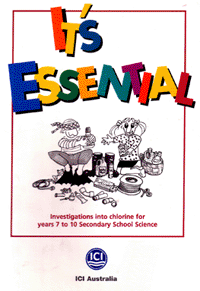
Similar materials were produced by individual chemical companies in Australia such as ICI Australia (now Orica) which produced a book on chlorine, aimed at Australian and NZ students, entitled It’s Essential: Investigations into chlorine for years 7 to 10 Secondary School Science.
| The basic argument promoted in chlorine industry materials is that both dioxin and chlorine are perfectly natural (and by implication safe or at least non-threatening), and in fact chlorine is an essential building block of the planet. Chlorine-based products made from this basic building block are not only useful and beneficial but essential to our way of life. There are risks associated with everything we do and any risks associated with chlorine-based products are minor compared to the benefits. |
|
The classroom materials produced by the American Chemistry Council also aim to “introduce chlorine as an important ‘building block,’ one of a handful of single elements that combine to form most of the matter on the earth”. In this way they can ridicule the idea of banning chlorine in manufacture and also imply that chlorine-based products merely extend a natural process of building with chlorine.
In contrast the Science Advisory Board of the International Joint Commission on the Great Lakes (IJC) concluded several years ago that, because of the persistent toxic substances it produces, “use of chlorine and its compounds should be avoided in the manufacturing process”.
Similarly the Governing Council of the American Public Health Association, one of the leading scientific and medical associations in the US, unanimously endorsed a resolution urging US industries to stop using chlorine. It stated “the only feasible and prudent approach to eliminating the release and discharge of chlorinated organic chemicals and consequent exposure is to avoid the use of chlorine and its compounds in manufacturing processes”.
Industry-sponsored school materials, however, argue that chlorine-based chemicals provide vast benefits to society that we cannot do without. ICI’s classroom materials stated:
"Chlorine: it’s all around you in nature; it’s at the centre of our manufactured world; and people use products based on it every day – its an amazing yet controversial chemical. Could we do without it? See what you think after you’ve read this story…. You can’t live without chlorine. That’s a fact… were you aware that every time you drink a glass of water, read a book, put on your raincoat, clean your teeth or travel by car, you’re using chlorine in some form!... chlorine comes from salt."
 The American Chemistry Council (ACC) has classroom activities entitled "Chlorine Chemistry: essential2life" that covers some of the uses chlorine is put to including water disinfectant and PVC pipes to deliver water supply. In another section, they claim "Chlorine Compounds Are Crucial for Survival".
The Council’s materials similarly stress the benefits of chlorine. One activity, “Chlorine in our Lives” involves giving students a list of products that are manufactured with chlorine. Students are asked to circle which products are found at their school or in their homes. Teachers are instructed: “Tell students that chlorine is present in many other compounds that are a common part of our daily lives.”
If you have any examples or updates you would like to contribute please email them to me and I will add them here. Please give references for where you sourced the information.





 Previous
 Next
Next