 |
Business-Managed Democracy » Education » School Choice » Subsidising Private Schools |
While efforts are being made in the US to direct government funds to private schools through vouchers and tax credits, in other parts of the world (see below) government subsidies to private school are increasing. The aim in each case is to aid private schools to provide more direct competition to public schools.
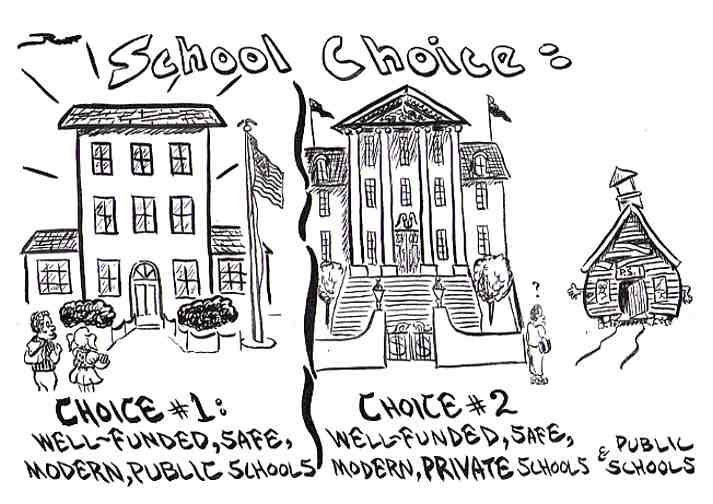

In Australia, successive Federal governments have been increasing subsidies to private schools “building them as a market-based alternative to the state school system”.
Large, and ever increasing, government subsidies have brought down fees in many private schools to be within reach of the middle classes. Catholic schools receive around 80% of their operating costs from federal and state governments and are therefore able to charge relatively low fees compared with other private schools. The Anglican church has also introduced new low-fee schools to augment its high-fee elite schools.
Consequently there has been a major shift in enrolments from public to private schools. “An ideology of parental ‘choice’ has been vigorously promoted, with the corollary that parents who care about their kids will always choose private schools.” This has fed the media-led public perception that private schools are superior and public schools are deteriorating.
In British Columbia privatisation was promoted, as in Australia, by diverting public funding to private schools. Private schools now receive 50 percent of the funding per pupil that public schools receive. As in Australia, these private schools are mainly religious schools with some non-religious, elite schools. The proportion of students attending private schools is increasing with the government funding.

Traditionally public schools were a recognition that “unequal circumstances of children’s lives are not of their own making” and that all children are entitled to an equally good education, “regardless of their parents’ beliefs, capacity to pay, or personal circumstances”.
As a consequence of the current business push for competition and choice in schools, combined with the reluctance of corporations and the wealthy to pay their fair share of taxes to properly fund public schools, there are now three tiers of education: private schools that cater to the elites who want to give their children social and educational advantages; other private and selective public schools that are adequately funded and able to control their enrolments; and inadequately-funded public schools whose doors are open to any child, whatever their socio-economic background, religion, or ability.
If you have any examples or updates you would like to contribute please email them to me and I will add them here. Please give references for where you sourced the information.




 Previous