 |
Business-Managed Democracy » Government » International Coercion » Lobby Groups » Trilateral Commission |

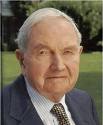 The Trilateral Commission is a top level international think tank founded in 1973 by David Rockefeller (pictured), chair of Chase Manhattan Bank, and Zbigniew Brzezinski, national security advisor to President Carter. It has 390 elite members made up of former and future national leaders, including George W. Bush and Bill Clinton, and corporation heads, bankers and politicians. It meets annually as well as holding regional meetings.
The Commission claims it drew together 'the highest-level unofficial group possible' so as 'to foster closer cooperation among these core democratic industrialized areas of the world with shared leadership responsibilities in the wider international system'. Originally members were from Japan, Europe and North America but it has since widened its membership to include Chinese, Indian, Mexican and Asian members.
The Trilateral Commission has been funded by David Rockefeller, the Charles F. Kettering Foundation, and the Ford Foundation. Although members hold high level positions in business and academia, or have held such positions in government, they attend meetings as private individuals and therefore are free from the constraints of having to represent their orgnaisations.
Holy Sklar in her book on Trilateralism, says the purpose of Trilateralism is to protect the power of the international ruling class “whose locus of power is the global corporation”; to co-opt the Third World; and to reintegrate communist countries:
The Commission's purpose is to engineer an enduring partnership among the ruling classes of North America, Western Europe, and Japan—hence the term "trilateral"—in order to safe-guard the interests of Western capitalism in an explosive world.

According to David Rockefeller: "We [the transnational corporations] are now in the driver's seat of the global economic engine. We are setting government policies instead of watching from the sidelines."
Rockefeller wrote in Newsweek that business people favour lessening the role of government but that this means that “somebody has to take government’s place, and business seems to me to be a logical entity to do it.”
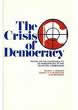 In a report entitled The Crisis of Democracy, the Commission argues that there is need for 'a greater degree of moderation in democracy' and that the 'effective operation of a democratic political system usually requires some measure of apathy and noninvolvement on the part of some individuals and groups':
The vulnerability of democratic government in the United States (thus) comes not primarily from external threats, though such threats are real, nor from internal subversion from the left or the right, although both possibilities could exist, but rather from the internal dynamics of democracy itself in a highly educated, mobilized, and participant society.
The Commission has promoted the deregulation of labour markets and reduction of welfare as part of its efforts to protect capitalism from the potential power of the working class.
Noam Chomsky noted in 1981 of the Carter Administration:
All of the top positions in the government — the office of President, Vice-President, Secretary of State, Defense and Treasury — are held by members of the Trilateral Commission, and the National Security Advisor was its director. Many lesser officials also came from this group. It is rare for such an easily identified private group to play such a prominent role in an American Administration.
Other members of the Trilateral Commission have included:
Barak Obama appointed 11 Trilateral Commission members (out of a total 87 US members) to high level positions in his administration in its early days.
Members of the Trilateral Commission may not hold current government positions and must give up their membership if appointed to office.
The Trilateral Commission had at least four members in common with the Brundtland Commission on sustainable development, including Maurice Strong, Earth Summit organiser, and Jim MacNeill, the principal author of Our Common Future, the Brundtland Commission’s report on sustainable development. Many transnational corporations that are members of the Business Council for Sustainable Development are also represented on the Trilateral Commission, including Dow, Du Pont, Royal Dutch Shell, Browning-Ferris Industries, Mitsubishi, Nippon Steel, Nissan Motor, and 3M.
The interest of the Trilateral Commission in sustainable development and the Earth Summit becomes more apparent in a book published by the Trilateral Commission and written by Jim MacNeill of the Brundtland Commission. In it MacNeill explains how most urban/industrial regions depend on environmental resources in other places, such as developing countries.
In essence, the ecological shadow of a country is the environmental resources it draws from other countries and the global commons. If a nation without much geographical resilience had to do without its shadow ecology, even for a short period, its people and economy would suffocate... Western nations heavily engaged in global sourcing should be aware of their shadow ecologies and the need to pursue policies that will sustain them.




 Previous
 Next
Next