
by Sharon Beder
first published by Allen & Unwin, Sydney, 1989
Introduction
Sewers seaward
Toothless watchdog
Toxic fish
Sewer-side surfing
Public relations battle
Events of 1989
Beyond Sydney
Conclusion
Bibliography
When the sewage comes to the surface of the ocean it is blown by the wind. When the wind is onshore the beaches are inevitably polluted. Many swimmers and surfers are aware of this and realise that the actual distance between the outfalls and the coast is insignificant. Richard Gosden of STOP (Stop The Ocean Pollution) pointed out in 1985 that the sewage already travels much further than the proposed two to four kilometres that the outfalls will extend. Beaches such as Long Reef had been closed several times that summer because of pollution, although the Manly outfall is 7.5 kilometres away.
STOP compared the extended outfalls to the strategy used in Europe some years before, when smoke stacks from coal-burning power stations were made higher because of localised pollution. The raising of the stacks merely led to the further spread of acid rain throughout the whole continent. STOP argued that the extended outfalls would, likewise, ensure the further spreading of sewage pollution up and down the coast.
Drogue experiments were carried out by engineers between 1958 and 1978 to predict the movement of surface fields. The trajectories of these drogues were plotted and are shown in the accompanying diagrams (Maps 3, 4 & 5). The drogue experiments purported to show that 43 per cent of the time at North Head, 23 per cent of the time at Bondi and 39 per cent of the time at Malabar the sewage field would have reached shore and affected nearby beaches if there was a surface held.
Map 3 Path of free-floating drogues released offshore from North Head
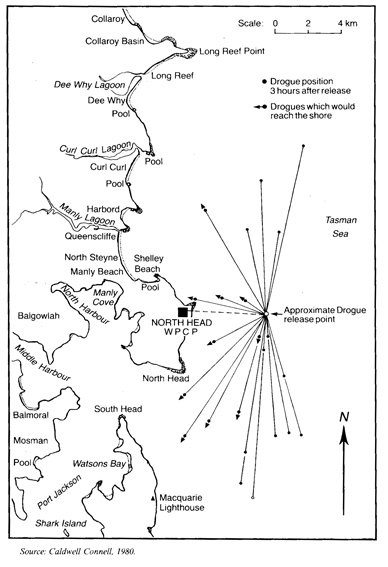
Experiments carried out by the Water Board and their consultants found that when there is a surface field, sewage will come onshore 43% of the time from the North Head extended outfall. Each line in the diagram above which has an arrowhead on it represents a drogue, or weighted float, that would have come onshore. The positions shown in the diagram show where the drogues got to in just three hours.
Map 4 Path of free-floating drogues released offshore from Bondi
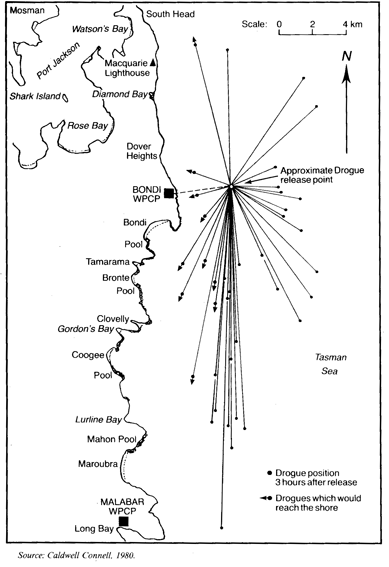
Experiments carried out by the Water Board and their consultants found that when there is a surface field, sewage will come onshore 23% of the time from the Bondi extended outfall. Each line in the diagram above which has an arrowhead on it represents a drogue, or weighted float, that would have come onshore. The positions shown in the diagram show where the drogues got to in just three hours.
Map 5 Path of free-floating drogues released offshore from Malabar
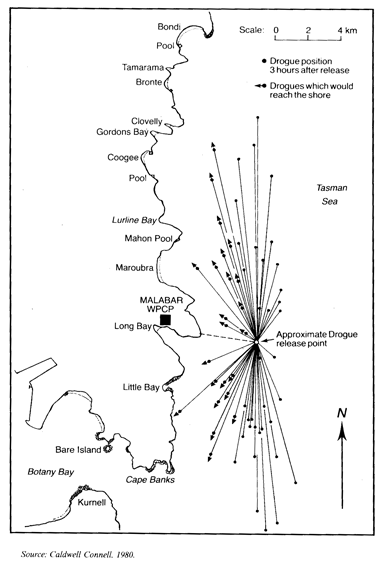
Experiments carried out by the Water Board end their consultants found that when there is a surface field, sewage will come onshore 39% of the time from the Malabar extended outfall. Each line in the diagram above which has an arrowhead on it represents a drogue, or weighted float, that would have come onshore. The positions shown in the diagram show where the drogues got to in just three hours.
Previously in this chapter Swimming in a secondary treatment plant Next in this chapter: Contents page is at http://www.herinst.org/sbeder/Books/toxicfish.html
Introduction to this chapter
Citing irrelevant data on health risks
Extended ocean oufalls--a reduction in risk?
Consequences of a submerged field