|
|
Mid-South Coast Newsletter
October 2022 |
|
|
|
|
|
|
|
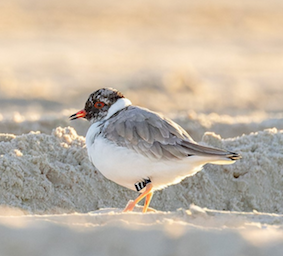
Hoodie T7, a well-travelled hooded plover. Photo by Jacob Crisp NPWS. |
|
|
|
|
Hooded Plover’s Long Journey
A critically endangered hooded plover from Eurobodalla National Park flew a record-breaking 1700 kilometres to the NSW North Coast and back.
"After being spotted in July at Evans Head in the Broadwater National Park, 850 km to the north of Eurobodalla, the young bird has travelled all the way back down to Wallaga Lake, just five kilometres south of where it hatched in January.”
It was identified by its leg band that had an engraved flag. The longest recorded distance flown previously by a banded hooded plover was 376km.
Hooded plovers are usually only seen on the South Coast of NSW. It is estimated that there are only 65 hooded plovers remaining in NSW. They nest on the beach and the main threat to them are domestic dogs and unaware beach-goers who disturb their nests.
Ref: Katrina Candie, Little Hoodie's big adventure: Rare shorebird migration a record-breaker, About Regional, 30 August 2023.
|
|
|
|
|
|
|
|
|
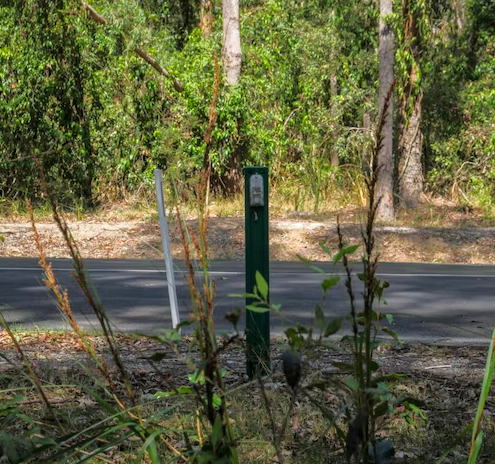
Photo of virtual fence by James Tugwell, ABC |
|
|
|
|
Success of Virtual Fencing
Eurobodalla Shire Council’s natural resource supervisor, Courtnee Fink-Downs, has proclaimed that the virtual fencing installed at Long Beach in October 2022 has been a success.
Before it was installed the Council was called out to wildlife roadkill incidents on that stretch of road around five times per week during peak summer periods. Since then there have been only five roadkills in the ‘fenced’ area. That is despite a 20 percent increase in wildlife roadkill incidents across NSW in 2023. (The overall increase is probably because of dry conditions causing animals to cross roads seeking food and water.)
The pilot virtual fencing program, which involved putting 48 posts at 25 metre intervals, cost only $11,500. It has been so effective that Eurobodalla Council is planning to install virtual fencing at a roadkill hotspot at Surf Beach later in the year.
The technology works best when vehicles are travelling at less than 80 km/hour so may not be suitable for highways.
Ref: James Tugwell, Eurobodalla Shire Council virtual fence trial credited with reducing roadkill incidents, ABC News, 23 September 2023.
|
|
|
|
|
|
|
|
|
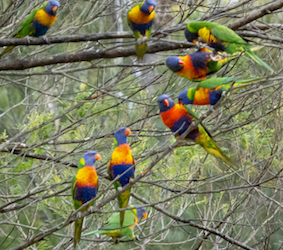
Photo: Rainbow Lorikeets by Sharon Beder |
|
|
|
|
Rainbow Lorikeets Move West
According to naturalist Ian Fraser, rainbow lorikeets, once limited to coastal areas, are now spreading across NSW.
"Every time I drive inland it seems I’m surprised at how much further they’ve pushed away from the coast. I suppose they follow flowering eucalypts, but doubtless get waylaid by orchards and gardens, and spread through towns as they reach them, gratefully harvesting flowers and fruit – and home bird feeders. And as they get established, people doubtless put out more food."
Ref: Ian Fraser, Spectacular, shrieking, sociable Rainbow Lorikeets spreading, fast, About Regional, 11 September 2023.
|
|
|
|
|
|
|
|
|
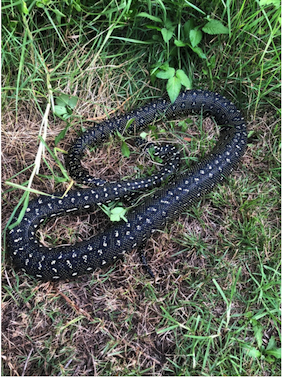
Photo: Diamond python by Kay Mallitt |
|
|
|
|
Snakes Are On The Move
by Sandy Collins, Shane O’Keefe and Kay Mallitt
Snakes are an important part of the Australian bush ecosystem and a protected species. Living close to bush means you may encounter a snake. The main species MSC WIRES snake handlers encounter are red-bellied black snakes, diamond pythons, the occasional death adder and brown snakes.
The east coast of Australia is also home to smaller species of snakes and legless lizards so it is important to remember that snakes cannot be identified by colour and size alone. Always treat any sighting as a potentially venomous species.
You might be wondering what to do if you come across a snake. If the snake is outdoors then slowly move backwards away as most snakes are more scared of you than you are of them. Keep children and pets away and give the snake 24 hours to move on. Most snakes don’t have a ‘territory’ so given time most will move on in their search for food.
If the snake is indoors then please call WIRES and one of our licensed and trained volunteer snake handlers will be out to assist as soon as possible. If you can keep an eye on the snake from a distance that will help the rescuer find and relocate it.
Snakes are firstly cowards and will avoid a human if they can. If that doesn’t work then they try and bluff their way out of a situation by rearing up and flattening out. As a last resort a snake will defend itself by biting if avoiding or bluffing doesn’t work.
WIRES' snake handlers have been called to a number of scenarios from snakes indoors, snakes hit by motor vehicles, snakes caught in unsecured and unsuitable netting, and even a snake in a motor vehicle.
If you have netted fruit trees or a netted vegetable patch please use the correct netting. Netting entangles bats, snakes, gliders and birds. If your finger can fit through the netting holes then it’s the wrong type and is a danger to our wildlife.
It is illegal to harm or kill any snake and penalties range from a fine of $10 000 and up to ten years in jail. The majority of snake bites occur when people try to harm a snake. |
|
|
|
|
|
|
|
|
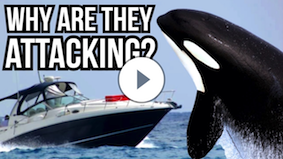
3 Potential Reasons Why Orcas Are Attacking Boats |
|
|
|
|
Orcas Attacking Boats
The incidences of orca whales attacking boats have been escalating in recent years. There were 52 orca boat attacks recorded in 2020 and 207 in 2022.
"What’s driving this apparent antagonism isn’t known, but social media has rushed to declare it an “orca uprising” against humankind’s continual overstep into their habitat… This persistent idea that Mother Nature herself might rise up to reject and even undo the damage done by humans appeals because it alleviates our sense of responsibility...
"Orcas are better placed than many species to adapt to our changing planet, what with their formidable intelligence, strong social structures and widely distributed population. Spectacular documentary footage has shown them capable of complex and collaborative problem-solving, precisely creating waves and breaking up ice floes to isolate their prey, and even using the tides to their advantage.
"But the challenges increasingly facing orcas are not the sort that can be got around with teamwork, brute strength or some slick strategising with ice. Warming seas are forcing them to alter their migratory routes, diminished ecosystems are reducing their food supply, and marine traffic and noise pollution are interfering with their ability to hunt and communicate. Resident populations (which stick to coastal waters, and are often endangered) are being exposed to chemical contaminants, with deleterious effects on their health and wellbeing."
Ref: Elle Hunt, Orcas are attacking boats. But to say they’re ‘fighting back’ is all too human, The Guardian, 20 July 2023. |
|
|
|
|
|
|
|
|
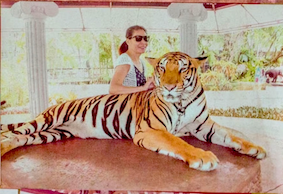
For $10, tourists can pose with this tiger at Phuket Zoo in Thailand. The tiger is held by a short chain and can’t stand up. Tigers may be declawed, or even drugged, to protect the tourists. Photo by Kirsten Luce. |
|
|
|
|
Suffering for Wildlife Tourism
Wildlife tourism has taken off in recent years thanks to social media. People flock to wildlife hotspots to get selfies with dolphins, tigers, elephants and other animals.
However, the happy pics don’t show the suffering those animals often endure behind the scenes.
"EcoValley’s guest book is filled with praise from Australians, Danes, Americans—tourists who often shun elephant camps such as Maetaman because the rides and shows make them uneasy. Here, they can see unchained elephants and leave feeling good about supporting what they believe is an ethical establishment. What many don’t know is that EcoValley’s seemingly carefree elephants are brought here for the day from nearby Maetaman—and that the two attractions are actually a single business.”
When not on show for tourists the elephants are chained up and have to sleep on hard floors. They are trained using painful jabs from metal hooks.
Tiger cubs are taken from their mothers and kept in small cages. Adult tigers are declawed and drugged. Chimpanzees are kept in chains. Bears are chained by their necks to get used to standing up. Dolphins that "have evolved to swim great distances and live in complex social groups” are kept in pools and turned into circus performers.
Ref: Natasha Daly, Suffering unseen: The dark truth behind wildlife tourism, National Geographic, June 2019.
|
|
|
|
|
|
|
|
|
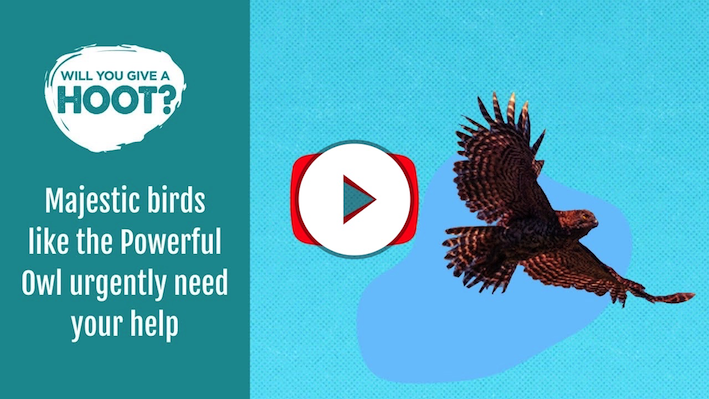
Video: Help save the Powerful Owl from rodenticide poisoning by Birdlife Australia |
|
|
Rat Poison Killing Owls
Most rat poisons sold in hardware stores and supermarkets are second generation anticoagulant poisons. It only takes one dose to kill a rodent but it may take a week for them to die.
As a result many rodent predators, in particular nocturnal birds such as the powerful owl and tawny frogmouth, are being poisoned. The poisons accumulate in the birds’ liver and muscle tissues and they gradually die from internal bleeding.
Researchers at Deakin University have found "alarming levels of rat poisons” in Australian nocturnal predatory birds. "Across four species, we found a staggering 92% of the 60 dead birds we tested had been exposed to these poisons... toxic or lethal impacts were likely to have occurred in 33% of powerful owls we tested, 68% of tawny frogmouths, 42% of southern boobooks and 80% of barn owls.”
What you can do:
- Use humane traps to catch rodents,
- clear food sources from around the house,
- block access to buildings, and
- ask your local stores not to sell rodent poisons.
Ref: John White and Raylene Cooke, Rat poison is killing our beloved native owls and tawny frogmouths – and that’s the tip of the iceberg, The Conversation, 25 August 2023. |
|
|
|
|
|
|
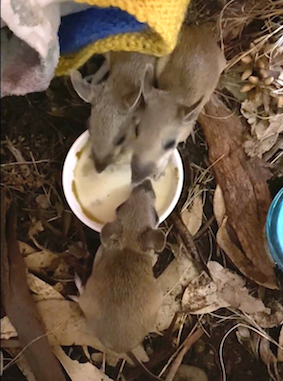
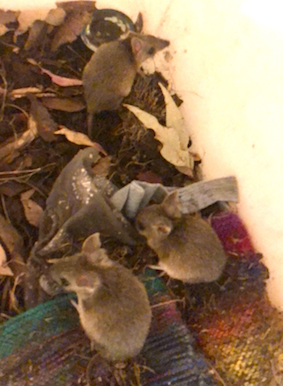
Bandicoot joeys, Pixie, Percy and Paddy enjoying a mixture of kangaroo milk, mashed banana, high protein powder and InsectaPro. They were rescued and initially cared for by Olympia Hendry, before going into Zora Brown’s care. Screenshot from video. |
|
|
Three weeks later, they have doubled in size. Photo by Zora Brown. |
|
|
|
|
What I learned from…
What I learned from raising bandicoot joeys.
by Zora Brown
Bandicoot joeys love sleeping together in a small woollen pouch on leaf litter and soil. An inner pouch is changed regularly as needed and the soil needs to be changed daily.
The joeys are highly prone to stress, especially when first coming into care, and handling must be kept to a minimum.
A large plastic storage container is great for housing to hold the soil and keep insects contained.
The joeys absolutely love digging their long noses deep into soil and under leaf litter, even before they know what to do with a live insect. Once they get the idea of catching and eating a live insect they need to be provided daily with loads of insects, such as crickets and cockroaches.
When they have progressed to eating solids, bandicoots will eat a mix of peas, corn, lean beef mince, finch seeds, mung sprouts, mushroom, banana and apple.
They grow rapidly and are released at the age of around 4 months before reaching sexual maturity.
Although they are a lot work, bandicoots are so much fun to raise. They are hilarious to watch as they hunt and squabble over food, moving in fast sporadic bursts. |
|
|
|
|
|
|
|
|
Some Pics from WIRES Mid-South Coast |
|
|
New Holland honeyeater with neurological issues. Rescue and photo by Zora Brown. |
|
|
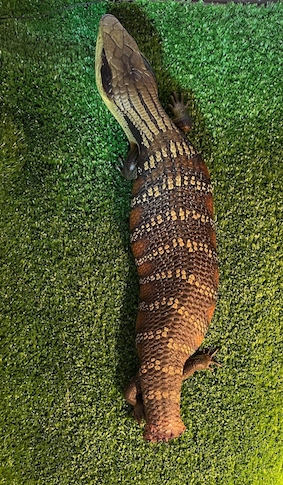
Blue tongue lizard, victim of a whipper snipper, was given surgery and is now recovering in the care of Sandy Collins. Photo by Shane O’Keefe. |
|
|
|
|
Petal, a brushtail possum joey rescued from Bawley Point, in poor condition with a huge tick on its eye, recovering in Zora’s care. Photo by Zora Brown. |
|
|
Ginger, a brushtail possum joey, lapping her milk. Care and photo by Debbie Ellis. |
|
|
|
|
Brushtail joey rescued from Surfside by Kylie, in care of Shelley. Photo by Kylie Lopes. |
|
|
Pinkie brushtail possum joey rescued by Olympia from Lake Conjola. Photo by Olympia Hendry.
|
|
|
|
|
|
|
|
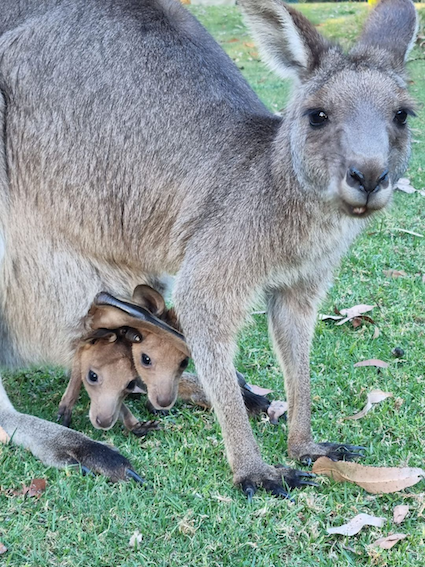
Pip, an eastern grey kangaroo reared by Lorita and Kevin, with her twin joeys. Photo by Lorita Clapson. |
|
|
|
|
"Buddies Napping”. Larry, the swamp wallaby joey, and Gucci, the eastern grey kangaroo joey, in the care of Beris. Photo by Beris Jenkins. |
|
|
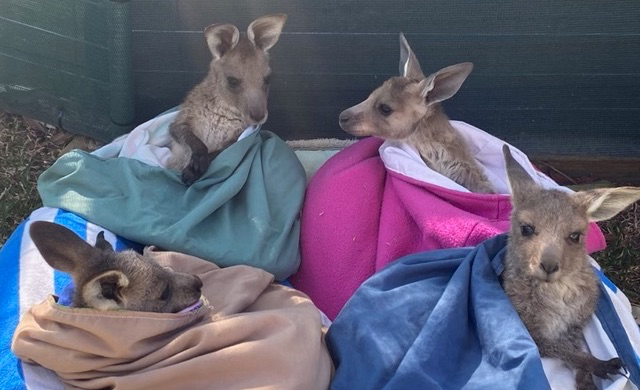
Ellie, Zalie and Millie, kangaroo joeys, meet Benji from Bingie. Care and photo by Renate Cooper. |
|
|
|
|
|
|
|
|
Notices
Branch General Meeting: Wednesday 8 November at 6.30pm at the Batemans Bay Soldiers Club - and also on Zoom.
Sandy Collins is now joint Reptile Coordinator with Kay Mallitt.
Sheryl Steele is now a qualified WIRES shooter.
|
|
|
|
|
|
|
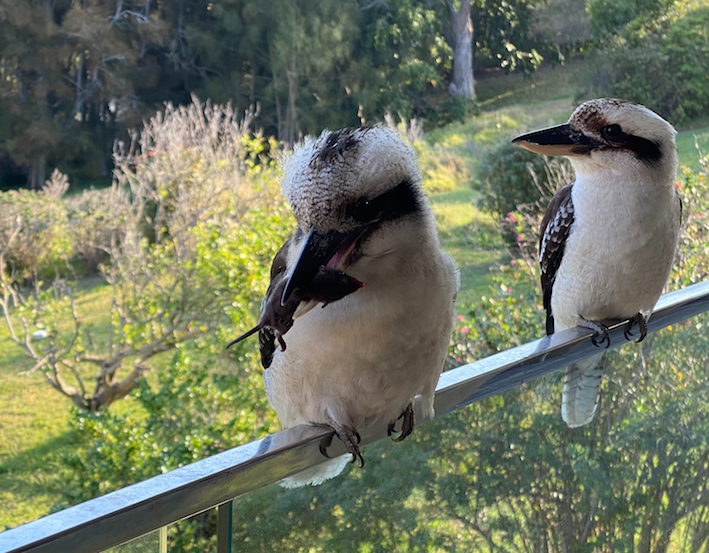
Kookaburra with antechinus, gifted from the other kookaburra (its mother?), at Malua Bay. Photo by Jenny Willis-Smith. |
|
|
|
|
|
|
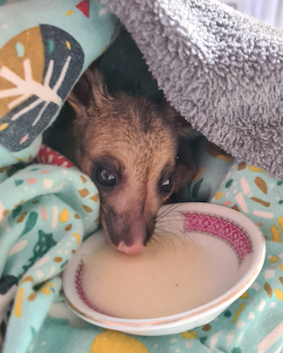
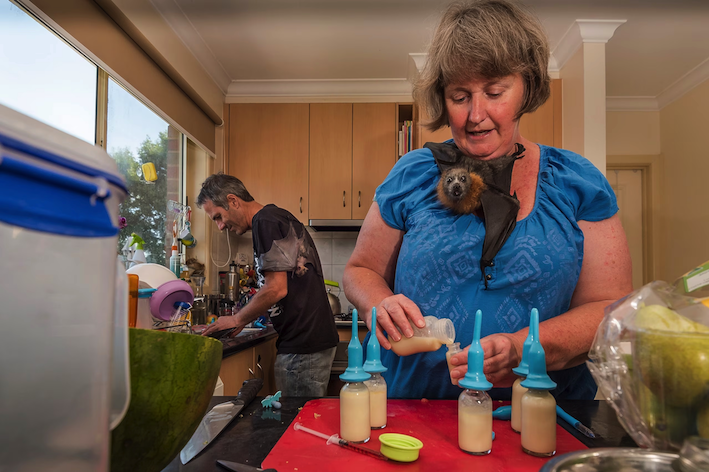
Julie and Graeme, two wildlife caretakers, prepare a meal for several recently orphaned gray-headed flying fox pups. In the wild the young would be hanging on their mother, but under care, they direct their affection and clinginess toward humans. Photograph by Doug Gimesy in National Geographic. |
|
|
|
|
|
|
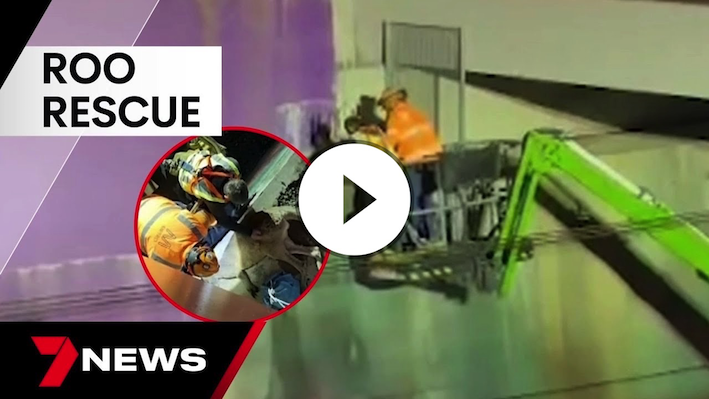
Featured YouTube: A tricky roo rescue – trapped 20 metres above train tracks |
|
|
|
|
|
|