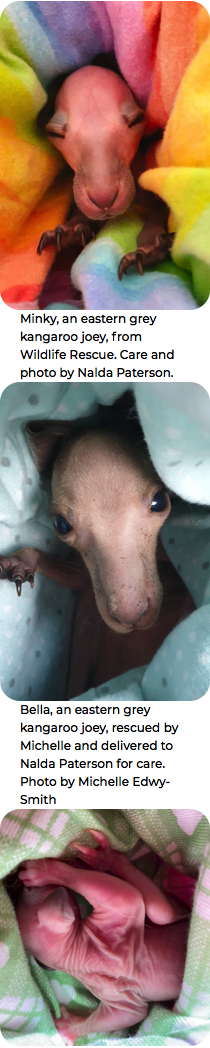
|
|
Mid-South Coast Newsletter
October 2021 |
|
|
|
|
|
|
|
Photos of greater glider rescue by Olympia Hendry |
|
|
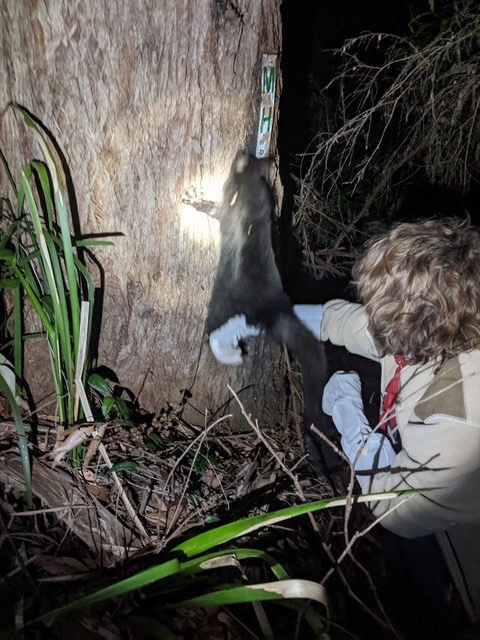
Olympia releasing greater glider. |
|
|
|
|
Greater Glider Rescue
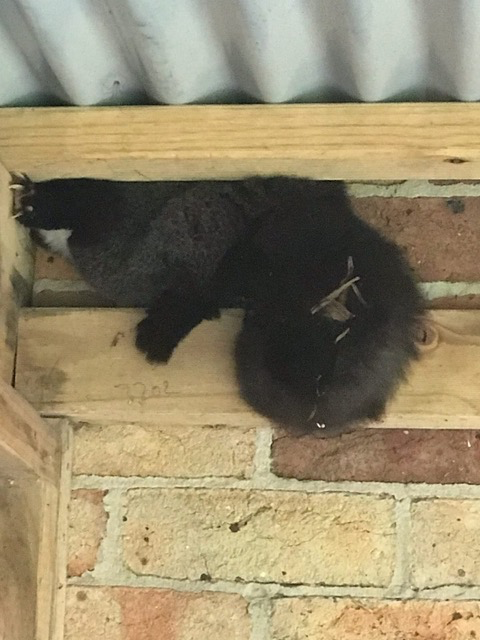
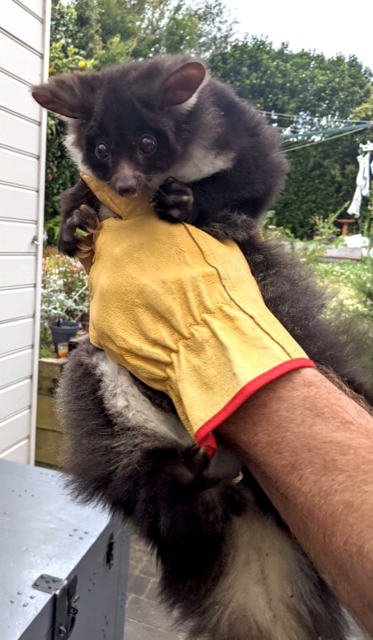
You wouldn’t expect to find a greater glider in a suburban carport. These beautiful creatures with luxurious long furry tails and sweet faces are Australia’s largest gliding mammal. However they are endangered, especially since the Black Summer bushfires that destroyed much of their habitat.
Greater gliders normally live in the forests, in large old trees with hollows for them to shelter and nest in. Yet WIRES received a call for the rescue of an unknown black furry animal with sharp claws stuck in a carport roof a few doors down from Millards Creek. The caller assured the WIRES rescue office that it was not a cat or a rabbit.
Olympia Hendry attended with her husband, Philip. Both had previously successfully protested against development of the nearby Manyana forest which is habitat to the greater glider.
Olympia had to manoeuvre the glider to get it out from under the roof, being careful to avoid its huge claws. However the glider was surprisingly docile, perhaps because it was in shock.
Olympia took the glider home and warmed it up and let it settle before attempting rehydration, though it was reluctant to drink. She kept it in a quiet area and had to avoid the temptation to keep checking on it and looking at it through the day as gliders are vulnerable to stress and that would have disturbed it.
Then at 9pm that night she and Philip took it to a more suitable location to release it. Rather than running away the glider turned around and clambered up Olympia while her husband shouted to her to protect her face. All was well and Olympia managed to get the the glider to a tree and returned him to the wild.
"The discovery and successful rescue and return to the wild of this rare and vulnerable glider highlights the importance of preserving viable wildlife corridors in urban developments”, said Olympia.
|
|
|
|
|
|
|
|
|
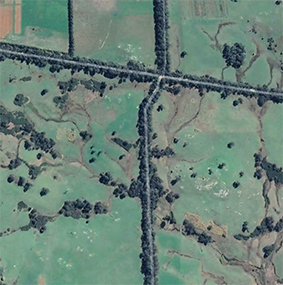
"Roadside and fenceline vegetation is often the only substantial remnant vegetation remaining in agricultural landscapes." |
|
|
|
|
Destroying Vegetation Now Allowed
The vegetation along fences and roadsides is often the only habitat left in farming areas for wildlife yet last month the NSW government made it legal for rural landowners to clear vegetation 25 metres outside their property boundaries. No approval is required.
This will be disastrous for species ranging from owls and greater gliders to native bees and the endangered regent honeyeater.
"Some plants, animals and fungi live in these strips of vegetation permanently. Others use them to travel between larger habitat patches. And for migratory species, the vegetation provides crucial refuelling stops on long distance journeys.”
The justification for these changes is to provide protection against bushfires but often these boundaries are far away from any dwellings and farm infrastructure and wildlife habitat should not be sacrificed just to protect wire fences.
Ref: Euan Ritchie et al, Destroying vegetation along fences and roads could worsen our extinction crisis — yet the NSW government just allowed it, The Conversation, 17 September 2021.
|
|
|
|
|
|
|
|
|
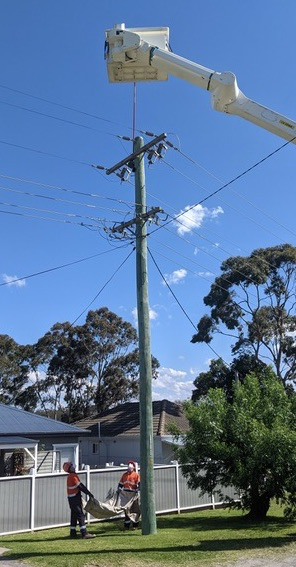
A worker in a cherry picker cabin with a non-conducting pole trying to nudge the possum down. Photo by Olympia Hendry. |
|
|
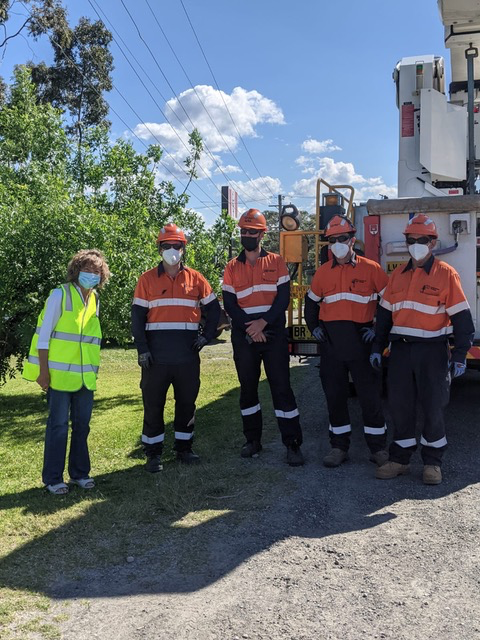
Olympia Hendry with Endeavour Energy workers, Dave Reilly, Greg Andrew, Luke Asmussen (Bindi) and Chris Smith, after the successful rescue of the brushtail possum. |
|
|
|
|
Endeavour Energy Help Possum
A brushtail possum has been rescued from a precarious position at the top of a high voltage power pole in Ulladulla by four patient men from Endeavour Energy.
A member of the public called WIRES to say the possum had been there for hours and seemed to be stuck and distressed, as well as displaying signs of heat exhaustion. Olympia Hendry arrived and realised the possum was in a very dangerous position, likely to be electrocuted if he moved either to his left or his right, possibly causing an electricity outage.
After making several phone calls to various authorities, Endeavour Energy sent two men out to assess the situation. They explained to Olympia that they couldn’t cut the electricity because there were people on life-support equipment reliant on the electricity from that pole. The idea of using food on a pole to entice the possum down was discussed but discounted as too dangerous.
So Endeavour Energy organised a cherry picker which arrived with two more Endeavour Energy workers. One of them went up in the cabin above the possum and, using a pole that didn’t conduct electricity, tried to nudge the possum down at a place where there were no wires. They had a safety blanket down below in case the possum fell. However the possum did not cooperate and merely went down to the next set of powerlines.
The cherry picker then approached from the side and, with everyone shouting instructions from below, nudged the possum again. They had all been in the wind and sun for more than 2 hours by this time. Suddenly the ungrateful possum scurried down the pole and disappeared into the nearby bushland before anyone had a chance to have a proper look at him.
WIRES has awarded the four workers, Dave Reilly, Greg Andrew, Luke Asmussen (Bindi) and Chris Smith, a certificate of appreciation. For their part, the men were thankful to have been able to bring down a live animal, for a change, as so often they have the grisly task of retrieving dead animals from the wires, including bats and even goannas.
|
|
|
|
|
|
|
|
|
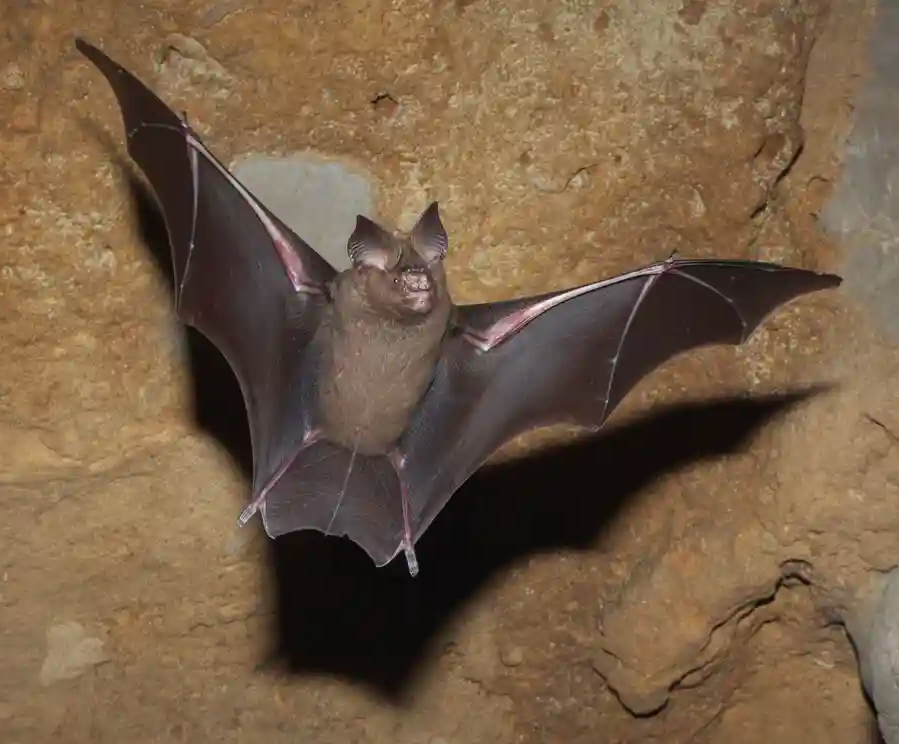
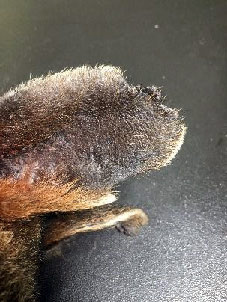
The great round-leaf bat’s wings have been shown to be increasing in size. Photograph: Nature Picture Library/Alamy |
|
|
|
|
Animals Changing Shape
Researchers have found that some birds and animals are changing shape in an attempt to cope with global warming.
"Examples include several species of Australian parrot that have shown a 4-10% increase in bill size since 1871, positively correlated with the summer temperature each year.”
Appendages not covered in fur or feathers, such as ears, beaks, tails and, in the case of bats, wings, are growing larger to enable better heat dissipation.
These evolving changes in shape will not necessarily protect wildlife from the impacts of climate change, which include more extreme weather events and bushfires.
Ref: Helena Horton, Animals ‘shapeshifting’ in response to climate crisis, research finds, The Guardian, 8 September 2021.
|
|
|
|
|
|
|
|
|
|
Eastern Barred Bandicoot
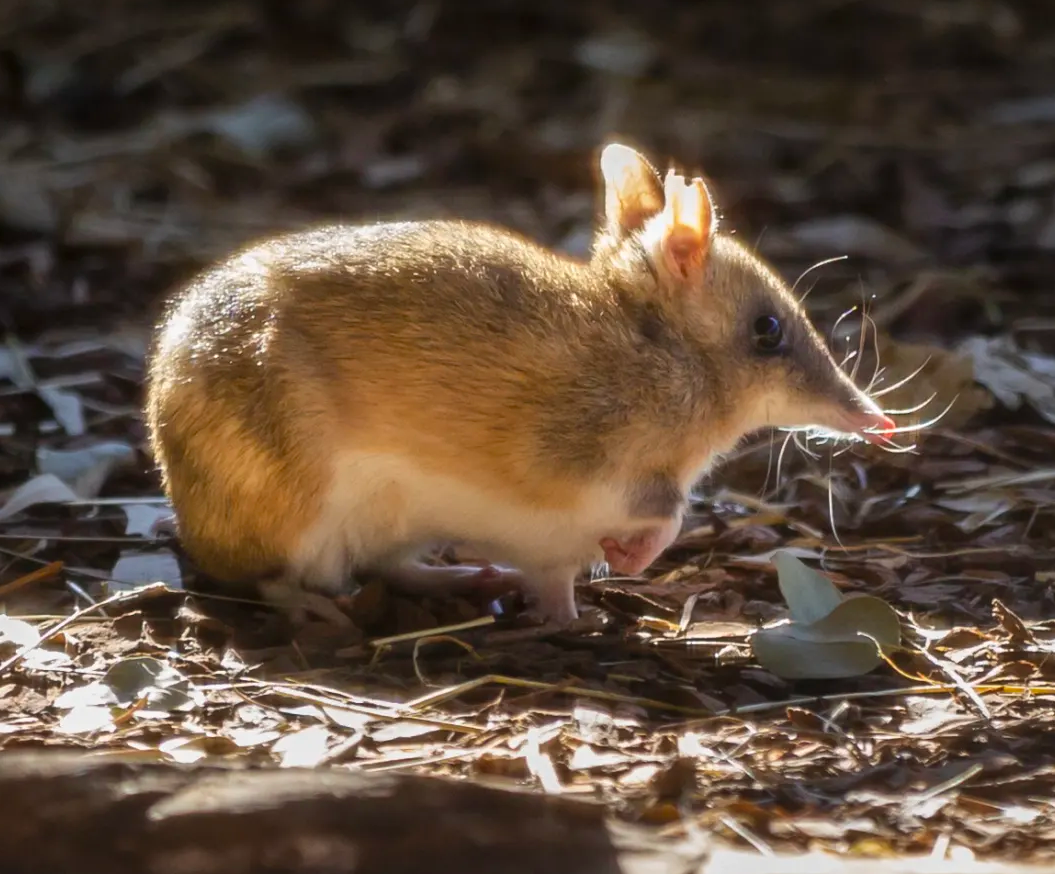
Eastern barred bandicoots have been successfully reintroduced into the wild in Victoria in a world’s first.
Once common, they were subject to predation by foxes and cats and had become extinct in the wild. The remaining population was protected by expensive fencing that was constantly monitored for breaches as part of a 30 year captive breeding program by Zoos Victoria.
The bandicoots have since been released on French Island and Phillip Island, which are fox-free, although not cat free. The bandicoots have successfully established themselves on these islands and are now classified as ‘endangered’ rather than ‘extinct’. They number about 1500.
Ref: Miki Perkins, Bandicoots back from the brink as status downgraded to endangered, Sydney Morning Herald, 15 September 2021.
|
|
|
|
|
|
|
|
|
|
Harming Trees with Nails and Screws
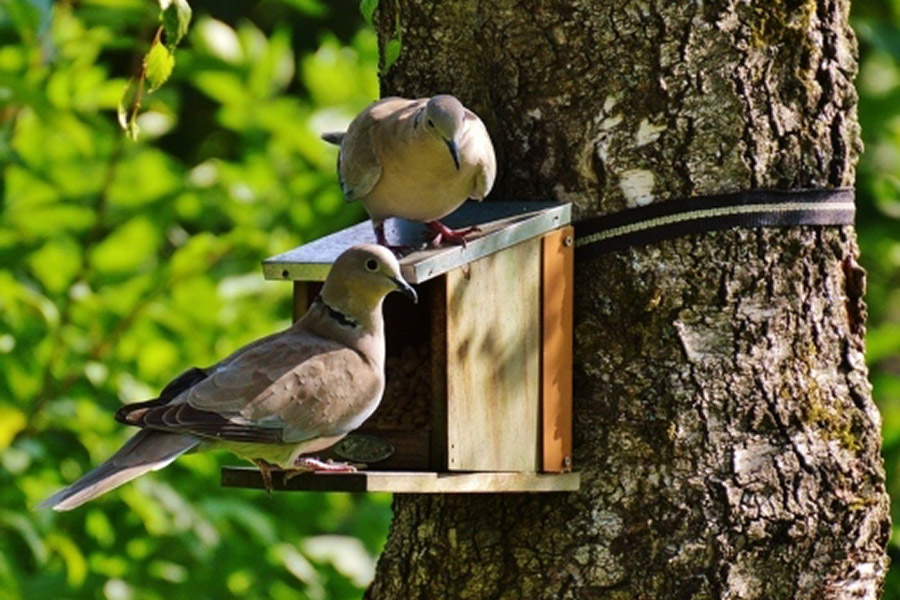
Using screws, nails or staples to attach things like nest boxes to trees can negatively impact the tree. Piercing the protective outer layer of the tree can make it vulnerable to infection by disease, fungi and insects.
If the inner cambium is pierced then the flow of water and nutrients from the roots to the canopy can be disrupted. If the tree grows around the inserted metal it can pose a hazard to future efforts to prune or cut the tree with a chain saw.
It is better to attach nest boxes using a wide strap or hose that won’t dig into the tree. If you must use nails or screws use stainless steel ones, use as few as possible, and make sure the tree is not too young, thin-barked or weak.
Ref: Do Nails, Screws, or Staples Hurt Trees?, RTec TreeCare, 17 January 2020.
|
|
|
|
|
|
|
|
|
|
Swamp Wallaby Ear Diseases
The Australian Registry of Wildlife Health is investigating reports of erosive ear lesions on swamp wallabies. A parasite has been found in the ear lesions on one animal.
The syndrome was initially discovered in swamp wallabies from southern NSW, but has since been found in swamp wallabies on Sydney’s northern beaches and further north.
If you see a case contact the Australian Registry of Wildlife Health.
|
|
|
|
|
|
|
|
|
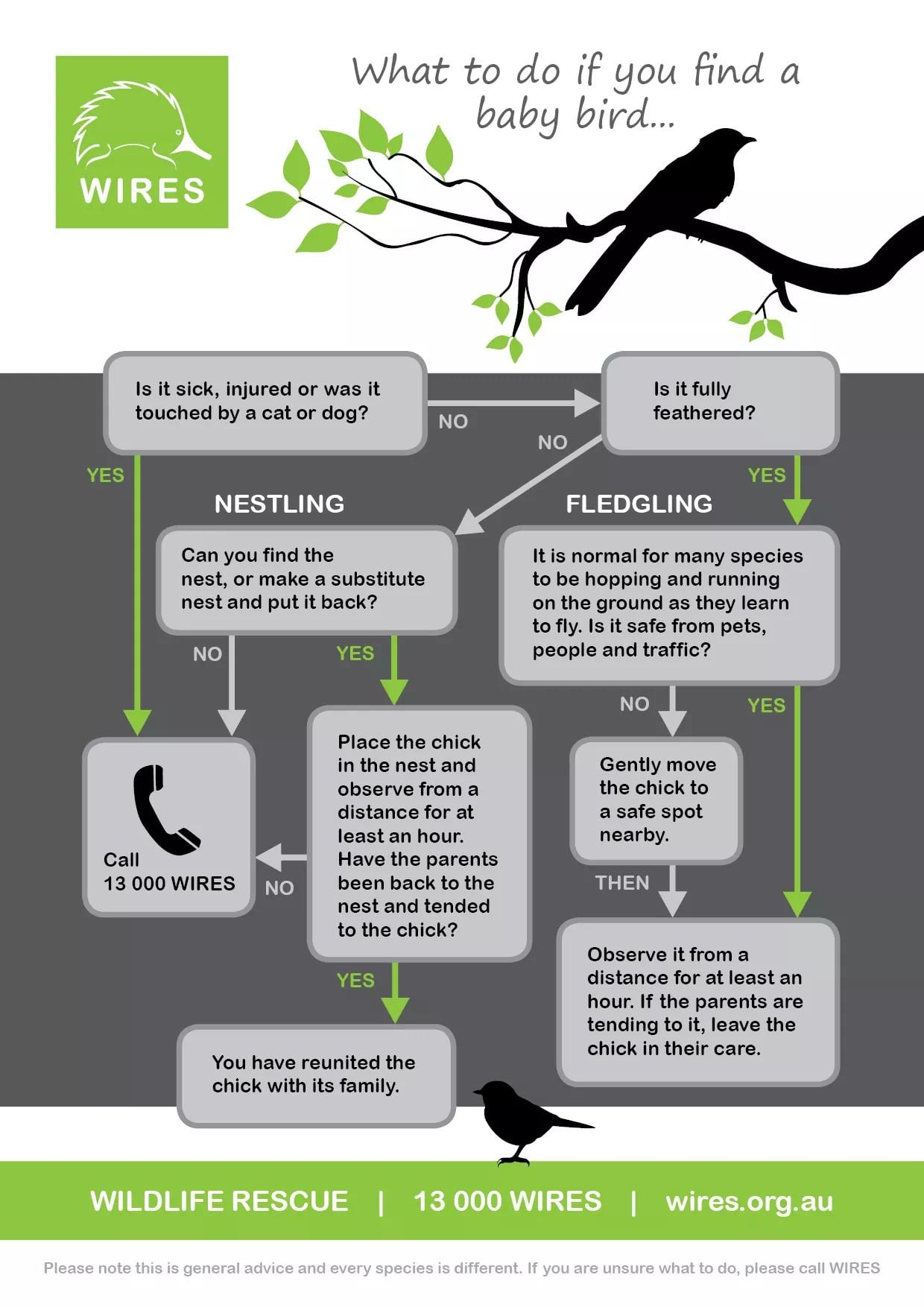
Nestling or Fledgling
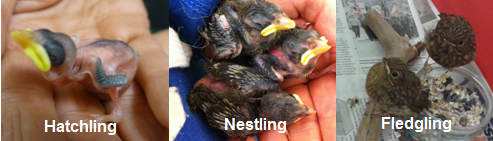
Often people see fledglings out of the nest and assume they need to be rescued because they are on the ground, unsteady on their feet and unable to fly. They seem to be vulnerable but, in fact, their parents are keeping watch over them while they learn to fly.
|
|
 |
|
A fledgling has feathers and is able to perch on a branch and hop around the ground. Keep threats, such as pets, away and if that is not possible put in on a branch or in a safe place nearby. Otherwise, if it is not injured, leave it alone.
A nestling is fluffy or downy and has few feathers and it is unable to perch on a branch or move about on the ground. If it is on the ground it is likely to have fallen out of its nest. Look around for the nest and put it back in if possible. If you can’t find or reach the nest put it in a container that can drain water line it with leaves or similar. Put it in a nearby tree.
In each case watch the bird from a distance for an hour or so to see if the parents come back to feed it. If they don't, the bird will need to be taken into care.
Ref: Alex Johnson, Nestling or Fledgling? Baby Bird Dos and Don'ts, Birds in Backyards, 27 August 2021.
|
|
|
|
|
|
|
|
|
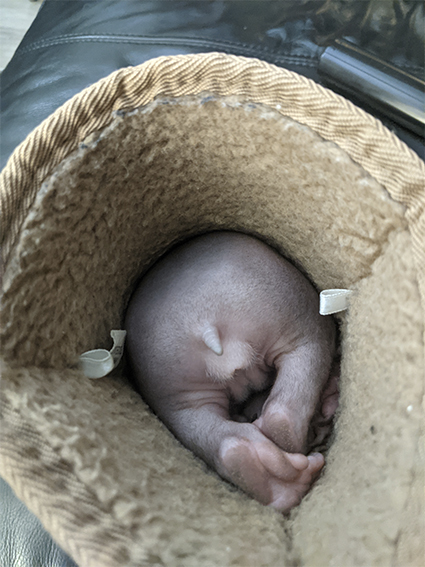
Petal, the wombat joey's first exploration resulted in her climbing into Olympia’s Ugg boot. She refused or couldn't get out so Olympia had to cut her out as if she was performing a wombat joey rescue from mother's pouch. Photo and care by Olympia Hendry. |
|
|
|
|
|
|
|
|
|
|
|
This brushtail possum joey, rescued by Alan Nash, was lying out in the open in full sun on someone’s lawn in Moruya Heads. The maggots in her eye were removed by Debbie Ellis and Shane O’Keefe with repeated rinsing and squeezing. Photo by Debbie Ellis. |
|
|
|
|
|
|
|
|
|
Some Pics from WIRES Mid-South Coast
|
|
|
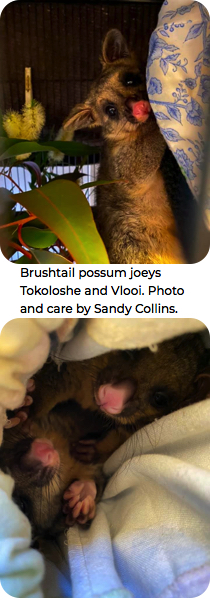
Brushtail possum joeys Fikizolo and Vlooi together in a pouch. Photo and care by Sandy Collins. |
|
|
|
|
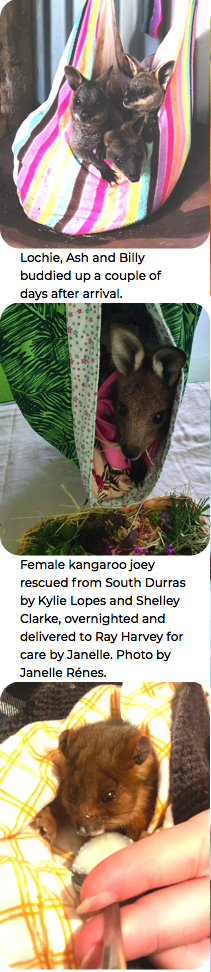
Lochie meeting Ash and Billy. |
|
|
Juvenile ringtail with dog bite injuries rescued from Mollymook Beach by Natalie. Photo by Natalie Moore. |
|
|
|
|
Hoppa, 2kg eastern grey kangaroo joey, handed to Shelley Clarke by a caring policeman. Care and photo by Debbie Ellis. |
|
|
Brushtail pinkie in care of Nalda Paterson. Photo by Sandy Collins. |
|
|
|
|
|
|
|
|
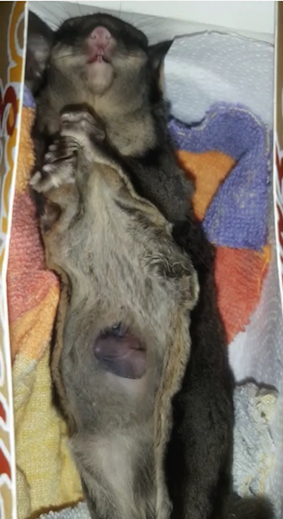
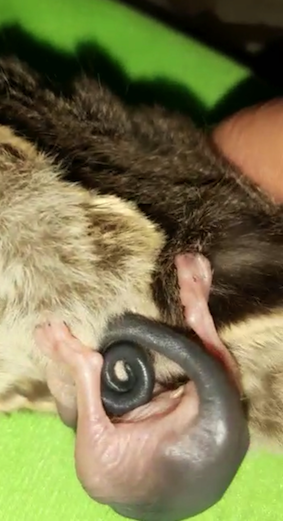
12g sugar glider joey still attached to its dead mother. Photos by Shelley Clarke. |
|
|
|
|
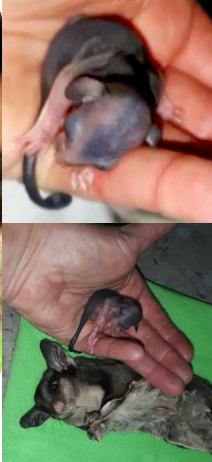
The sugar glider joey was rescued by Shelley Clarke, and hydrated every 3 hours during the night. Now in the care of Nalda Paterson. |
|
|
|
|
|
|
|
|
|
Woolies Food for Wildlife |
|
|
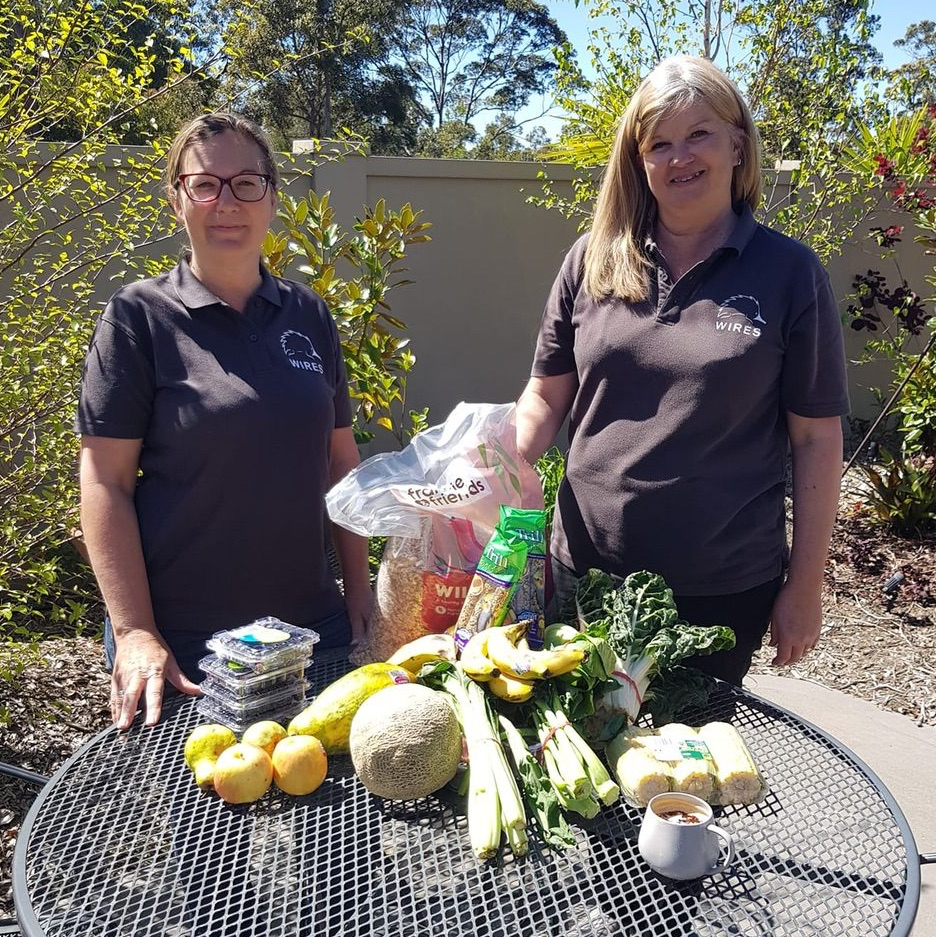
Janelle Rénes and Heidi Hovath with a hamper of food for in-care wildlife from Woolworths. The food, much of which would otherwise be discarded as being imperfect or near its use by date, is being donated to WIRES. Selected MSC members will arrange pick up and distribution. If you are interested in receiving some of this food, contact your local member below. Photo by Caroline Roberts.
- Ulladulla: Kristal Martin
- Batemans Bay: Heidi Hovath
- Moruya: Kathy Godwin
- Narooma: Sonja Herger
|
|
|
|
|
|
|
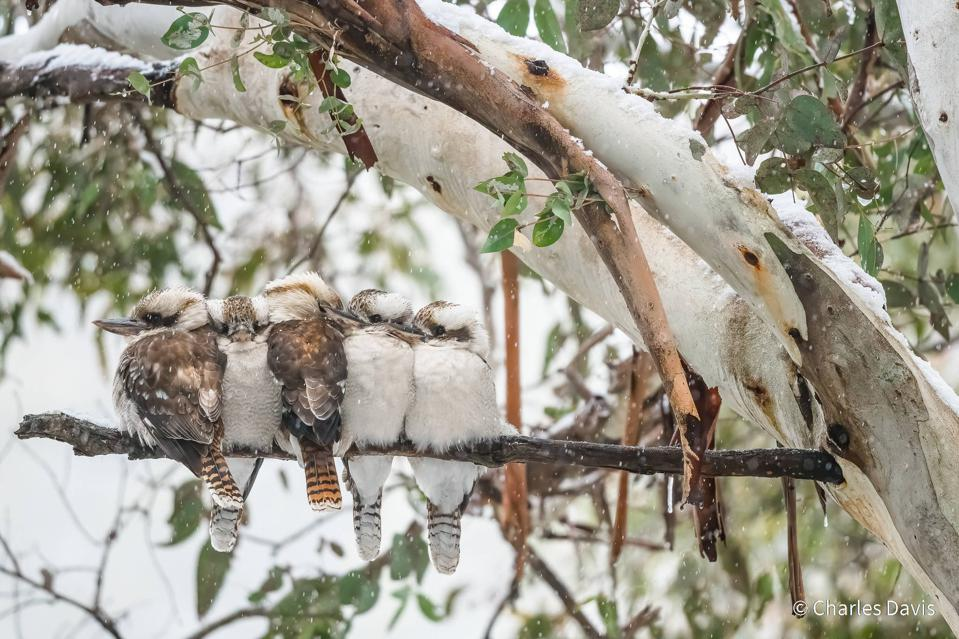
A family of Kookaburra birds huddles together for warmth during a blizzard in Kosciusko National Park, NSW. Better Together, Finalist, Animal Behaviour category, Australia Nature Photographer of the Year 2021. PHOTO: CHARLES DAVIS - AUSTRALIAN GEOGRAPHIC NATURE PHOTOGRAPHER OF THE YEAR 2021
|
|
|
|
|
|
|
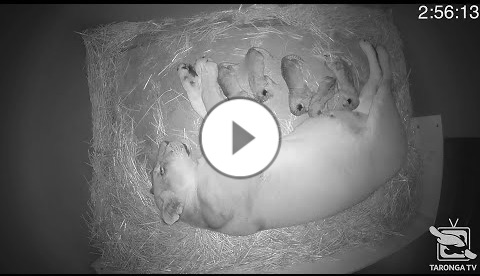
Featured YouTube Video: Lion Cub Birth at Taronga Zoo Sydney
|
|
|
|
|
|
|