|
|
Mid-South Coast Newsletter
March 2022 |
|
|
|
|
|
|
|
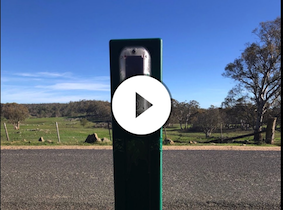
YouTube of virtual fencing operating.
|
|
|
|
|
Virtual Fencing Trial
Virtual Fencing for Wildlife was trialled along 1.5km of Old Bega Road from March 2020 with the aim of reducing wombats being killed by cars.
Virtual fencing uses devices at the side of the road that emit an alarm and flashing lights when triggered by car headlights. The aim is to warn wildlife that vehicles are approaching so they will get off the road.
Between 26 June 2017 and 4 February 2020, 23 wombats were killed in that stretch of road. Between 17 March 2020, after the virtual fencing was installed, and 1 February 2021, 6 wombats were killed in the ‘fenced area’. That is 0.7 wombats per month before the trial and 0.6 after the trial. The ratio of wombats killed outside the virtual fencing area was 1.9 per month before and 1.7 per month after the trial.
"The preliminary findings of this study suggest the fence at this site was minimally effective at reducing numbers of wombat deaths from roadkill”.
The researchers thought one reason virtual fencing in this trial was less effective than in a previous Tasmanian trial was because cars were going too fast on the Old Bega Road and the wombats did not have time to get out of the way after the alarm was sounded.
Ref: Hayley J. Standard et al., Can virtual fences reduce wombat road mortalities? Ecological Engineering 172, 2021.
|
|
|
|
|
|
|
|
|
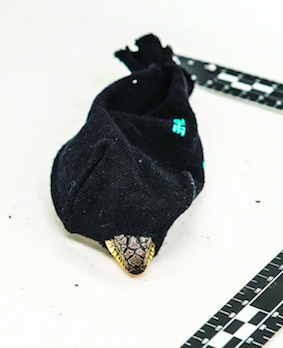
Photograph: Blue-tongued lizard in a sock by Doug Gimesy
|
|
|
|
|
Illegal Wildlife Trade
Almost 90 percent of animals that Australian authorities find being illegally traded are reptiles, including red-bellied black snakes.
"Australia has almost 900 native reptile species, of which more than 90 per cent exist nowhere else. Their unusual colourings, behaviours and genetic traits, the result of many millennia of evolution separated from the rest of the world, have made them highly valued on the international pet market."
Reptiles are bound up so they can’t move and put in a sock then mailed overseas, hidden inside items such as electronic devices, toys or shoes. If they make it past Australian customs there is little to stop them from reaching their destination and being openly sold in markets and online as pets.
"Trapped for days without access to air, water or food, they’ll enter a torpor-like state called brumation. This allows some to survive their horrific ordeal, but most won’t.” The high prices they sell for mean that only a few need to survive for the illegal trade to be worthwhile.
Ref: Justin Meneguzzi, Bound, gagged, posted, Australian Geographic, 23 December 2021.
|
|
|
|
|
|
|
|
|
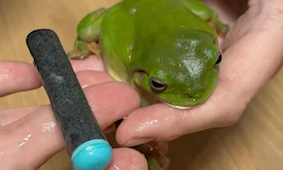
Green tree frog with the dart that was removed from it. Photo by Trish Prendergast. |
|
|
|
|
Frog Swallows Dart
When a family at Balgal Beach (near Townsville) found a resident green frog was a funny shape they called in Trish Prendergast, a veterinary nurse and reptile coordinator for the North Queensland Wildlife Centre. She removed the Nerf gun dart, which was as long as the frog.
“You would be surprised at what they shove in their mouths,” Prendergast said. “There would have been a bug or something on or next to the Nerf dart, so it’s gone for the bug, pounced on it to eat it and shoved the Nerf dart into its mouth.”
Normally when frogs accidentally swallow unwanted objects they turn their whole stomachs out of their mouths, remove the object, and swallow their stomachs again. However the dart was lodged diagonally in the stomach and it was unable to do this.
Ref: Royce Kurmelovs, ‘Bit off more than he could chew’, The Guardian, 10 Feb 2022. |
|
|
|
|
|
|
|
|
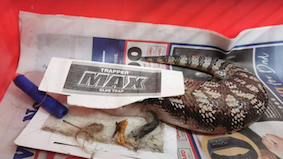
A blue tongued lizard rescued from a glue trap by veterinary nurse Teanele Hayes. Photo by Teanele Haye. |
|
|
|
|
|
|
|
|
|
Seabird ecologist Lisa O’Neill microchipping a little penguin chick at Snapper Island in the Clyde Estuary. |
|
|
|
|
Microchipping Penguins
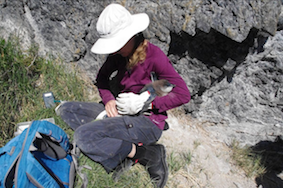
For the last few years Eurobodalla Council’s sustainability team have been joined by volunteers at Snapper Island; keeping invasive weeds in check and removing marine debris. The work helps the little penguins who use this Clyde Estuary (Bhundoo) island as a safe place to nest and raise chicks.
More recently, seabird scientists Lisa O’Neill and Nicholas Carlile have been helping the team manage the colony. The researchers have caught and microchipped the penguins for the last two breeding seasons, which will allow the birds to be tracked over time.
Council’s supervisor of natural resources Heidi Thomson said little penguins began breeding at around three years of age and had a seven-year lifespan.
Due to predation, including by dogs and cats, little penguins no longer breed on the NSW south coast mainland. Snapper Island penguins appeared to be thriving.
To protect the sensitive ecosystem and breeding site, Snapper Island has a no landing policy. Eurobodalla Council has information on the Clyde Little Penguin project, with fact sheets, activities and videos, at this link. |
|
|
|
|
|
|
|
|
|
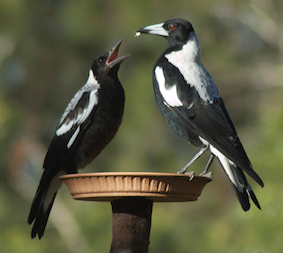
Altruistic Magpies
When researchers attached tiny, backpack-like tracking devices to magpies, the magpies helped each other remove the devices. The researchers admitted that "the birds outsmarted us”.
They watched as a female magpie without a tracker used her beak to remove the tracker from a younger bird. Within 3 days all five birds with trackers had had them removed, including the dominant male.
"While we’re familiar with magpies being intelligent and social creatures, this was the first instance we knew of that showed this type of seemingly altruistic behaviour: helping another member of the group without getting an immediate, tangible reward."
Ref: Dominique Potvin, Altruism in Birds?, The Conversation, 22 February 2022. |
|
|
|
|
|
|
|
|
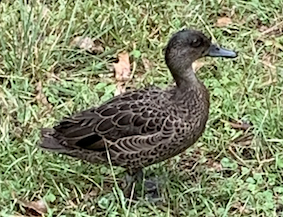
Photo: Grimm, the female chestnut teal by Sharon Beder |
|
|
|
|
What I learned from…
NEW SECTION: Calling for contributors.
What I learned from preparing a chestnut teal duckling for release was:
1. She would only eat her greens (clover and bits of kale) and worms when they were in the water of her clamshell pool. (Mealworms she would eat anywhere, anytime.)
2. She needed to have her drinking water next to her mushy pellets so she could go back and forth between them with every mouthful.
3. After four days in the aviary she would follow me everywhere, even back into the cage, with a few short detours for exploration before hurrying to catch up.
Sharon Beder |
|
|
|
|
|
|
|
|
|
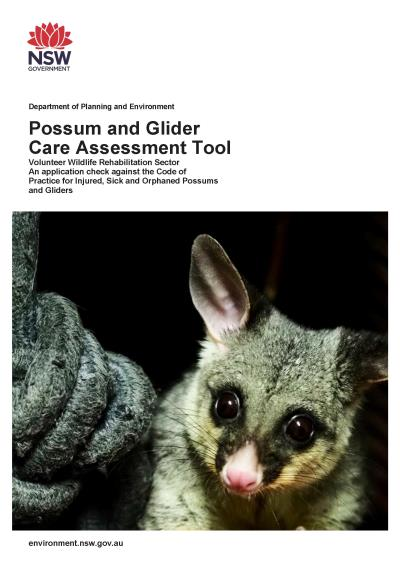
Wildlife Rehabilitation Standards
"Licensed wildlife rehabilitation providers must ensure that the welfare needs of injured and sick native animals are met so the conservation benefits from their rehabilitation and release are optimised."
The latest updates provided by the NSW Department of Planning, Industry and Environment include:
Ref: Wildlife Rehabilitation Standards, NSW Department of Planning, Industry and Environment, accessed February 2022. |
|
|
|
|
|
|
|
|
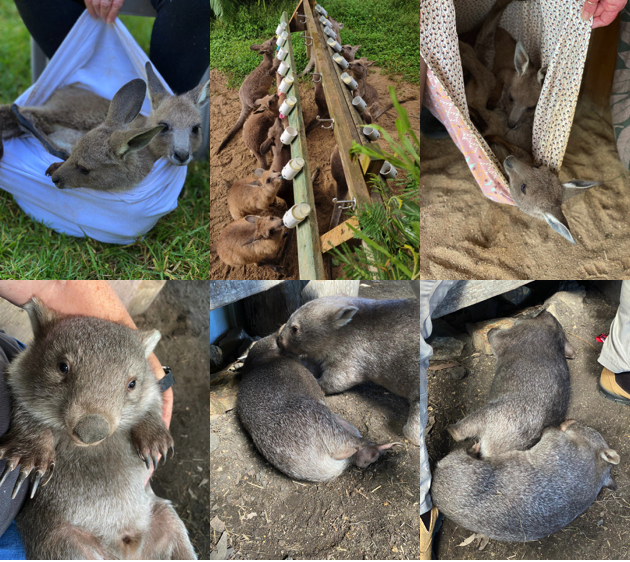
Some Pics from WIRES Mid-South Coast |
|
|
Orphaned bowerbird chick. Care and photo by Kayla Calder. |
|
|
Three ducklings. Two wood ducklings were survivors of a tree felling, and the third is a teal duckling. Care and photo by Natalie Moore. |
|
|
|
|
Bella, the kangaroo joey, whispering sweet nothings to Debbie Ellis. |
|
|
|
|
Grey headed flying fox, Lucky, rescued from a netted fruit tree, about to be transferred to his new carer and several buddies in Nowra to continue healing recovery. Photo by Janet Jones. |
|
|
Red-bellied black snake rescued from shoe by Kay Mallitt. |
|
|
|
|
|
|
|