|
|
Mid-South Coast Newsletter
February 2024 |
|
|
|
|
|
|
|
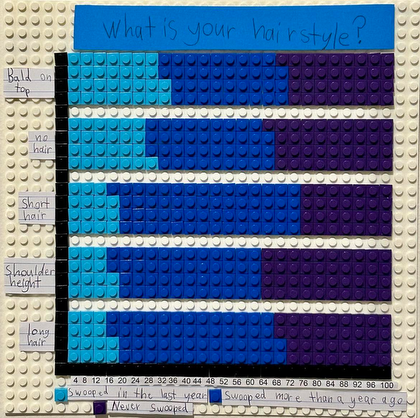
Emma’s Lego block bar chart.
|
|
|
|
|
|
|
Student Magpie Survey
Emma Glenfield, an 8 year old, year 3 student at Blue Mountains Grammar School, noticed the local magpie, Mr Swoopsalot, seemed to be mainly swooping the dads visiting the school. So she conducted a survey for a maths project.
"I watched the people he swooped and I recorded it," Emma said. "Then I got everything I recorded and I figured out that they [the people Mr Swoopsalot swooped] were male, they were tall, and that they had thin or receding hair.”
Emma’s mother also helped her set up an online survey which went viral. Over 30,000 people participated in Emma’s survey from around the world.
"According to magpie expert Darryl Jones, professor emeritus at Griffith University, it's the first time anyone has ever examined the link between magpie swooping and appearance.” And the sample size of over 30,000 is much larger than other professional researchers have been able to gather.
Her research, which she presented using Lego blocks, won the NSW Investigating with Mathematics competition in 2023.
Ref: Tom Melville, Magpies swoop bald men more often, eight-year-old's viral survey finds, ABC News, 9 January 2024.
|
|
|
|
|
|
|
|
|
|
|
Echidna Puggles
by Debbie Ellis
Pugsley was found on Broulee island and was rescued by Shelley and Dave Clark in mid-November. He was 158g, about 59 days old and nearly dead. He has thrived in my care and by early January was 650g.
Priscilla came into my care a month later. She was found lying on her back in north Moruya and not responding. She was very dehydrated and starving. She was 507g and about 78 days old. Three weeks later she was 770g. |
|
|
Pugsley and Priscilla in the puggle enclosure (above).
|
|
|
|
|
|
|
|
Priscilla (black) is powering on and will be released soon. Pugsley (brown) has had a few weight problems but is now gaining weight again. Priscilla and Pugsley enjoy each other’s company and in the photo above are cuddling up whilst sun-baking. |
|
|
|
|
|
|
Kingfishers being cleaned, dried and then released. Photos by Zora Brown and Margot Hadfield |
|
|
|
|
Four juvenile kingfishers were found at South Durras caked in mud (see below). They were rescued by Shelley and Dave Clarke, then driven north to be cleaned up by Margot Hadfield with the help of Zora Brown and Bella. They were dried in an incubator and kept overnight before being driven home and released by Margot. They flew up into the trees to be reunited with their parents. Thanks to everyone who advised and assisted; a fantastic team effort.
|
|
|
|
|
|
|
|
|
|
Ginger the Brushtail Possum Joey
by Sasha Ermichina
Ginger, a brushtail possum joey, came into my care in early September 2023. She was orphaned, 190g and a sick little possum for a while.
When she got better, Ginger didn’t want to be buddied with Biscuit, another brushtail possum joey. She was finally soft released at my property towards the end of November at 250 days old.
As the milk decreased and then stopped, she protested by climbing our bedroom window fly screen and munching on succulents (I need to move the aviary further from the house!).
Ginger accepted her fate and now just comes for a visit every now and then, looking down on us drinking wine 🥰 She looks like a happy healthy plump possum.
|
|
|
|
|
|
|
|
|
Photo: Injured heron by Jenny Willis-Smith |
|
|
|
|
Heron at Birdland
A call for the rescue of a heron outside the Birdland ostrich enclosure required Jenny Willis-Smith and her friend Sue to don waders while Rachel McInnes kayaked over Joe’s Creek.  The heron had badly injured legs and could not move. The heron had badly injured legs and could not move.
|
|
|
Photo of Jenny and Sue wading in for the rescue by Rachel McInnes |
|
|
|
|
|
|
|
|
Photo: Flying fox pup in care of Janine Davies by Penny Burfitt. |
|
|
|
|
Shortage of Carers for Flying Foxes
Along the east coast of Australia, grey-headed flying foxes are starving and abandoning their pups. There are not enough carers for the influx of pups and so some are having to be euthanised.
"University of Sydney flying fox researcher and wildlife carer Kerryn Parry-Jones said exhausted mothers struggling to produce milk for babies were making mistakes like landing on powerlines.” She says Sydney wildlife groups are getting up to 10 pups a day from electrocuted mothers.
South Coast Wildlife Rescue have 60 flying foxes in care. Janine Davies is currently caring for over 20 flying foxes at her home in Bomaderry, many of which have been transported from other parts of NSW. "A typical day for the carers includes washing the babies' wraps, cutting up kilos of fruit for the adults, and being available every four hours to bottle-feed the orphans."
Dr Parry-Jones has called for carers to be paid. She does not believe that volunteers can be expected to provide the required care, given the numbers of flying-foxes requiring it, without support.
Ref: Penny Burfitt, Wildlife carers overwhelmed as grey-headed flying foxes experience mass starvation down Australia's east coast, ABC News, 7 January 2024.
|
|
|
|
|
|
|
|
|
Photograph: Mother kangaroo killed by a motor vehicle. by Michelle Edwy-Smith. |
|
|
|
|
Insurance for Kangaroo Collisions
The number of motorists claiming insurance for hitting kangaroos was 39 percent more in NSW in 2023 than in 2022, according to data collected by the Insurance Australia Group (IAG).
IAG attributes the increase to more vehicle movements post-COVID but WIRES data for our branch suggests that there is a general upward trend in motor vehicle accidents with macropods from before COVID.
The insurance claims increased more in NSW than in any other state with Dubbo having the largest number in any city, followed by Goulburn. The worst months were July to October.
Ref: Michael Dahlstrom, Costly insurance claims for Aussies hitting kangaroos on the rise - here's why, Yahoo!finance, 25 January 2024.
|
|
|
|
|
|
|
|
|
|
Legal Action Against Forestry Corp
Conservation group South East Forest Rescue (SEFR) is seeking an injunction stopping Forestry Corporation NSW from logging anywhere in the North East or South East forests unless
they conduct effective surveys for greater gliders.
At issue is the definition of a glider den tree in the the legal framework that governs logging in state forests: the Coastal Integrated Forestry Operations Approval (CIFOA). A glider den tree is defined as one "that includes, but is not limited to, a tree-hollow or other hole, crevice or fissure in a tree, which the subject species is seen entering or leaving”. If a den tree is found then logging is not permitted within 50m of the tree.
The Forestry Corporation argues that if it doesn’t see a glider coming or going from the tree during its survey it is not a den tree. However it does the surveys during the day when the gliders are sleeping.
In a new development the EPA has removed the need for Forestry Corp to do surveys and maintain a 50m exclusion zone around den trees. Instead, Forestry Corp will have to keep 14 large, hollow-bearing trees per hectare in high-density glider areas (up from 8).
"Experts are furious and say the change will fast-track the glider’s slide towards extinction, given each animal uses between six and 20 den trees, and also needs food trees nearby."
Refs: Unprecedented Legal Action Launched Against Forestry
Corporation NSW For Failing to Protect Endangered Species, Moruya Mail, 19 January 2024; AAP, Glider's fate at stake in forest battle over fine print, Daily Mail Australia, 27 January 2024; AAP, Greater glider put on path to extinction by NSW environmental watchdog, experts say, The Guardian, 2 February 2024.
|
|
|
|
|
|
|
|
|
A photo of the start of a Buruli ulcer supplied by the University of Melbourne. |
|
|
|
|
Buruli Ulcer from Possums
Scientists have found that the Buruli ulcer is being transmitted from possums to humans via mosquitos. This flesh-eating bacteria affected hundreds of Australians in 2023. The bacteria creates toxins that destroy skin cells, blood vessels and fat under the skin, causing the Buruli ulcer.
The first diagnosed case of Buruli ulcer originating in NSW occurred in August last year in Batemans Bay. Two earlier cases in the area were then discovered. "All three people are understood to have been infected locally and are the only local transmissions observed in New South Wales to date.”
Buruli ulcer has been regularly found in Queensland, Victoria and the Northern Territory.
"Buruli ulcer typically starts as a painless nodule or papule, often mistaken for an insect bite, and eventually progresses into an ulcer which can last many months with undermined edges (where the infection is mostly below the surface of the skin, in the subcutaneous tissue).
"Patients typically report symptoms around four to five months after being bitten by a mosquito. However, in some cases symptoms may not appear for up to nine months.
"Early recognition and treatment are important. Effective treatment consists of eight weeks of special antibiotic therapy. Anyone who is concerned about a non-healing skin ulcer should see their General Practitioner."
Refs: Locally transmitted Buruli ulcer cases identified on the NSW south coast, NSW Health, 8 September 2023; Danielle Cahill and staff, Mosquitoes spread flesh-eating bacteria that causes Buruli ulcer from possums to humans, scientists say, ABC News, 24 January 2024.
|
|
|
|
|
|
|
|
|
|
Puzzle-Solving Possums
Researchers have put puzzles throughout WA's Dryandra woodlands south east of Perth and filmed animals trying to locate the food in them.
The aim is to test animal problem-solving skills in a non-invasive way in the their native habitats. The animals have to push levers and slide panels to access the food.
Of the 12 species filmed only the brushtail possums and the brush-tailed bettongs (woylies) were able to solve all three puzzles.
In challenging times the ability to solve problems could be crucial to a species’ survival.
Ref: Jamie Thannoo, Native wildlife show off puzzle skills as animal researchers investigate problem-solving, ABC News, 15 January 2024.
|
|
|
|
|
|
|
|
|
Known Flying Fox Camps in Eurobodalla |
|
|
|
|
|
|
This expandable map indicates the locations of known flying-fox camps within the Eurobodalla Shire. Camps are the home for flying-foxes during the day, and the animals forage at night, often travelling long distances for food. |
|
|
|
|
|
|
|
Grey-headed flying fox monitoring 30 January 2024, Eurobodalla Shire Council. |
|
|
|
|
|
|
WIRES Emergency Response and Recovery Plan |
|
|
WIRES has allocated a fund of $90 million to projects, with over 20% of funds expended by October 2023 and the remaining funds committed to be spent in the future. Note the majority of the money is for increasing capacity for wildlife research, rescue and rehabilitation nationally rather than support for existing volunteers.
More info: WIRES Emergency Fund Update, WIRES, October 2023. |
|
|
|
|
|
|
WIRES Rescue 101 Volunteers |
|
|
WIRES head office has introduced a new type of volunteer that bypasses the normal recruitment, training, membership and supervision by WIRES Branches. The following is an advertisement for WIRES Rescue 101 volunteers.
WIRES Advertisement
WIRES is looking for volunteers to attend basic rescues, contain sick and injured wildlife and transport them urgently to a nearby veterinary clinic. No experience necessary as training is provided (via the Rescue 101 training program), which covers basic wildlife rescue skills, including handling and transportation, WHS consideration and first aid.
Commitment: Regular - more than 6 months
Training: The WIRES Rescue 101 Training Course costs $25 and can be completed solely online in 3-4 hours. This training consists of an online theory component only.
Time required: WIRES uses a Rescue Communication System that communicates with volunteers via an easy-to-use app. Volunteers involvement is flexible, with individuals having complete control over their availability. WIRES volunteers are not obliged to attend any rescues that they are not comfortable or available to attend. All individuals can choose how and when they wish to spend their time volunteering for WIRES. |
|
|
|
|
|
|
Some Pics from WIRES Mid-South Coast |
|
|
Red-browed finch chick rescued at Tuross Head by Janet Jones, hydrated and fed by Rachel and released back into its parents care by Janet. Photo by Rachel McInnes. |
|
|
Pied Cormorant juvenile, rescued from Guerrilla Bay by Dave Clarke. It had a wing injury and was unable to fly. It was under-nourished and had a severe lice infestation. Photo by Shelley Clarke. |
|
|
|
|
Little forests bat, Vulturnus vespedalus, female 3.95g, rescued by Beris Jenkins from wall in a holiday park at Narooma. Care and photo by Janet Jones. |
|
|
Swan rescued by Christa and transferred to Seabird Rescue. Photo by Christa Mood. |
|
|
|
|
Tiny bandicoot joeys Kit and Kat, 35g. Care and photo by Zora Brown. |
|
|
Male kangaroo joey rescued by Kay Mallitt from Catalina Golf Course, transported by Shelley to be cared for by Beris Jenkins. Photo by Shelley Clarke. |
|
|
|
|
|
|
|
|
Notices
Branch General Meeting, Wednesday 6 March, 6.30-8.30pm at the Batemans Bay Soldiers Club. Dinner for those interested at the Bistro at 5.30pm.
|
|
|
|
|
|
|
Harlow Cooper with the possum palace she made. Photo by Renate Cooper |
|
|
|
|
Certificate of Appreciation
At the recent meeting of our branch, 11 year old Harlow Cooper, Renate’s granddaughter, received a certificate of appreciation and some gifts for the help she has given Renate rescuing and caring for wildlife. Harlow crocheted a 'possum palace' for possum joeys in care (see left).
|
|
|
|
|
|
|
|
|
A tawny frogmouth fledgling transferred from Olympia Hendry’s care for pre-release care at Lorita and Kevin Clapson's. Photo by Sheryl Steele. |
|
|
|
|
|
|
Featured YouTube: Whale Protects Diver From Shark |
|
|
|
|
|
|
WIRES MSC Branch Species Coordinators
-
Avian  Rachel McInnes - POTATO POINT - 0419 863 966 and Janelle Renes - LONG BEACH - 0421 637 678 Rachel McInnes - POTATO POINT - 0419 863 966 and Janelle Renes - LONG BEACH - 0421 637 678
-
Raptors  Shane O’Keefe - BROULEE - 0415 142 859 and Sandy Collins - SURF BEACH - 0418 657 637 Shane O’Keefe - BROULEE - 0415 142 859 and Sandy Collins - SURF BEACH - 0418 657 637
-
Flying Fox & Microbats  Shelley Clarke - TOMAKIN - 0447 151 971 Shelley Clarke - TOMAKIN - 0447 151 971
-
Reptiles   Kay Mallitt - CATALINA - 0417 215 831 Kay Mallitt - CATALINA - 0417 215 831
-
Macropods  Beris Jenkins - NAROOMA - 4476 4203 Beris Jenkins - NAROOMA - 4476 4203
-
Possum/Gliders/Small Mammals (incl Echidnas)   Renate Cooper - NAROOMA - 0401 712 630 Renate Cooper - NAROOMA - 0401 712 630
-
Wombats  Kevin & Lorita Clapson – EAST LYNNE - 0407 684 277 Kevin & Lorita Clapson – EAST LYNNE - 0407 684 277
Other Appointments
|
|
|
|
|
|
|
|




 data-dm-src-width-hint="630" width="630" height="354"/>