|
|
Mid-South Coast Newsletter
August 2021 |
|
|
|
|
|
|
|
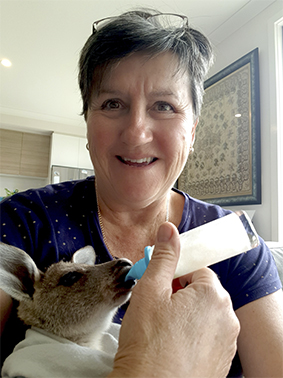
Caroline (Caz) Roberts with Zac |
|
|
|
|
Caz Roberts, Branch Secretary
Caroline Roberts moved to Long Beach from Queanbeyan 3 years ago, after retiring from the Federal Police where she worked for 14 years. She served in an unsworn capacity and was not a police officer but provided support services. During her time with the police she spent 4 years with peace-keeping missions in the Solomon Islands and Papua New Guinea.
Caz had always been interested in wildlife and while still in Queanbeyan, joined Wildcare, a NSW volunteer wildlife rescue and rehabilitation organisation, where she was an active member for 7 years. She still helps organise their telephone roster.
Since coming to Long Beach, Caz has joined WIRES and has been busy with rescues in her local area as well as caring for a wide variety of birds. She also has done some short-term stints caring for kangaroo joeys.
Caz finds birds endearing and loves the way she is able to get close to creatures that are otherwise out of reach. She finds releasing them back into the wild particularly rewarding. As a carer she also observes that birds have the advantage that they sleep at night!
Caz was keen to take on the role of secretary for the branch as she believes admin stuff is just as important as hands-on rescue and caring. She particularly likes the way our branch is run with its approach to membership that is based on the kindness principle, for both humans and animals. She finds the kindness principle inspirational and tries to apply it to other areas of her life.
Since coming to Batemans Bay, Caz has been welcomed into the WIRES community and found herself part of a close-knit supportive group.
|
|
|
|
|
|
|
|
|
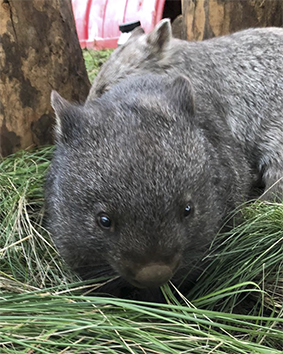
Declan, the wombat joey, a year ago. |
|
|
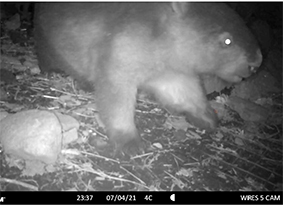
Giant wombat that gave Declan a hiding. |
|
|
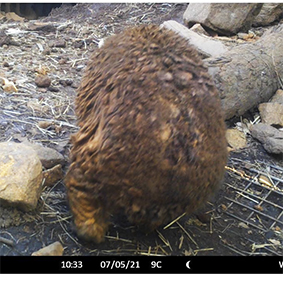
Declan, limping and bleeding. |
|
|
|
|
Wombat Soft Release Story
by Zora Brown
At the end of May it was time to open the gates and let wombats Nellie and Declan out of their enclosure to come and go as they please.
Those of you who have visited my place will know the enclosures are not at all close to the house. We drive down and up a very steep hill some 300 meters to get there.
After about one week we noticed Nellie was no longer coming back, and Declan was quite upset about it, obviously fretting.
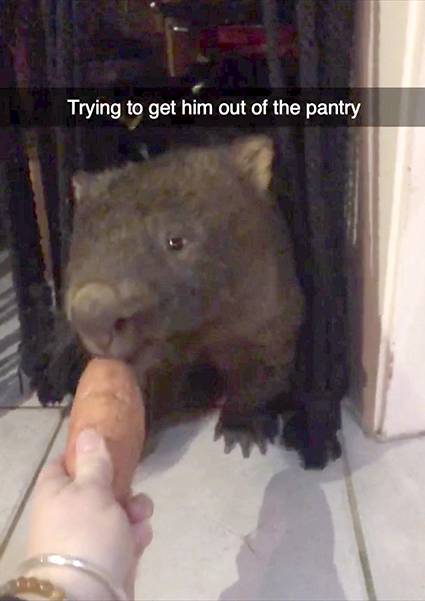
My elderly parents came to stay with us and on the second night, at 2:30am we heard an almighty crash in the living room. I thought my father, who suffers from dementia, had become lost on his way to the bathroom. We all ran over to help only to find Declan had busted his way into the house through the doggie door! He had knocked over a shelf causing a huge mess and looked quite guilty. Who would have thought!
So we took out the doggie door (sorry Dingo) and I also set up a night camera to see if Nellie could be spotted.
Two or three weeks later footage reveals Declan running and screaming back to his burrow followed by a huge local wild male. Several hours later the big guy has left and Declan comes out limping with blood on his back. A very stressful, sad sight for us to see but, as coordinator Tony de la Fosse says, it is totally normal and happens every night in the wild.
Declan also no longer tolerates me near his burrow. He becomes quite aggressive, showing me that he is now a wild animal.
A few days after that our daughter yells out at 2:15am, “There is a wombat in my room!” Once again Declan broke into the house, again through dog door, but this time I was just happy to see he was okay. He was not limping and the wound was fine. What a relief!
A week after that Declan showed us his skills once again by opening up a sliding door to come in. So now we have to lock everything; garage doors and all sliding doors… so clever!
Finally Nellie is back, once again sleeping in the same burrow with Declan. We wonder where she went for a whole month… Perhaps the big guy will be father of her future joey? She is, after all, two years old now.
|
|
|
|
|
|
|
|
|
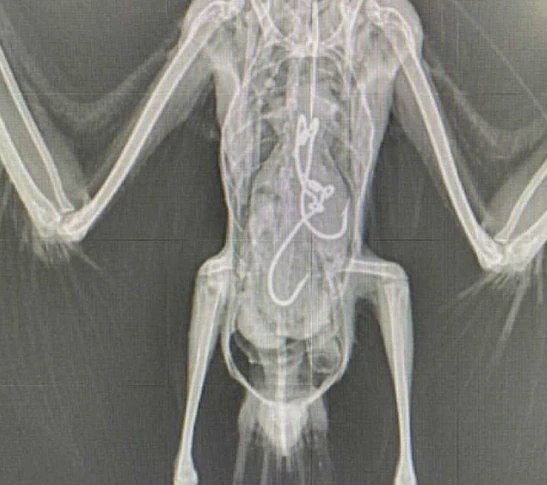
X-ray of pelican that had swallowed fishing hooks. It did not survive. Photo by Australian Seabird Rescue |
|
|
|
|
Fishing Endangering Wildlife
The number of seabirds injured by fishing tackle have increased dramatically on the north coast of NSW due to the increased popularity of recreational fishing. Birds that have been reported to Australian Seabird Rescue include pelicans, seagulls, cormorants and gannets. Not all of them can be caught for treatment and rescuers have to earn their trust over days of feeding them.
During the recent school holidays the number of reports have increased from one a week to one or two a day. The problem is that some fishers, particularly those new to fishing, don’t understand the importance of not leaving hooks and other fishing paraphernalia around.
Ref: Hannah Ross and Bruce Mackenzie, Australian Seabird Rescue says wildlife is paying the price for fishing boom, ABC North Coast, 15 July 2021.
|
|
|
|
|
|
|
|
|
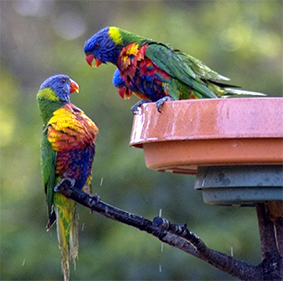
Photo: Rainbow lorikeets by Sharon Beder |
|
|
|
|
What’s Killing Lorikeets?
A mystery toxin is killing rainbow lorikeets in northern NSW and southern Queensland. According to University of Sydney researchers, hundreds, sometimes thousands, of rainbow lorikeets in that region suffer from “lorikeet paralysis syndrome” between October and June each year.
"The syndrome can cause limb, neck, and tongue paralysis, and an inability to blink or swallow, rendering birds unable to fly and feed, and therefore, survive.” The team has ruled out known toxics such as pesticides and believe the toxin comes from a plant the birds feed on.
Ref: Loren Smith, You can help identify what’s killing lorikeets, University of Sydney News, 15 July 2021.
|
|
|
|
|
|
|
|
|
|
Cockatoos Learning to Open Bins
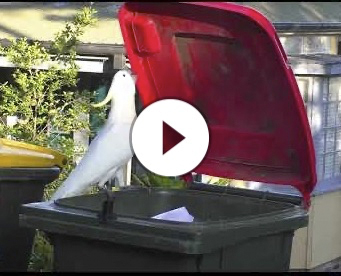
Sulphur-crested ockatoos learn how to open wheelie bins to find food by watching other cockatoos do it, according to a study in Science Magazine. This behaviour spread from three suburbs in Sydney in 2018 to 44 suburbs in 2019 as cockatoos copied each other.
Ref: Gemma Conroy and Tim Swanston, Cockatoos learn how to flip open garbage bins by copying each other, ABC Science, 23 July 2021.
|
|
|
|
|
|
|
|
|
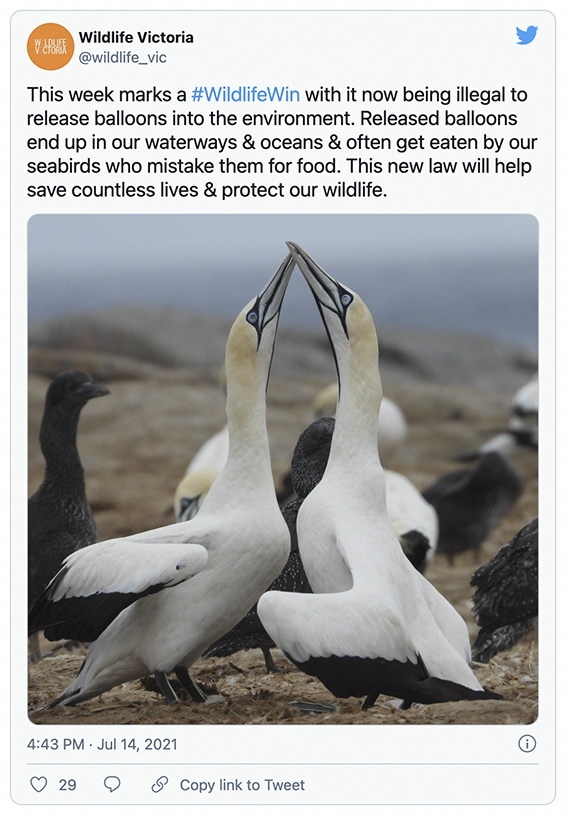
Illegal to Release Balloons in Victoria
In July it became illegal to release balloons in Victoria.
|
|
|
|
|
|
|
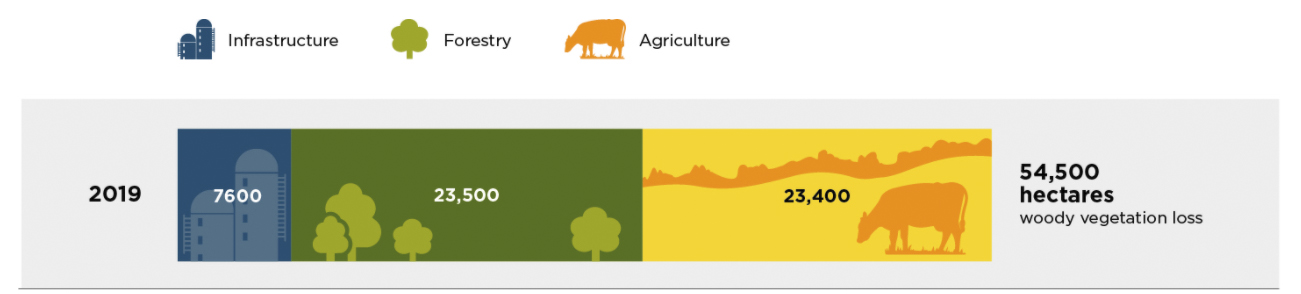
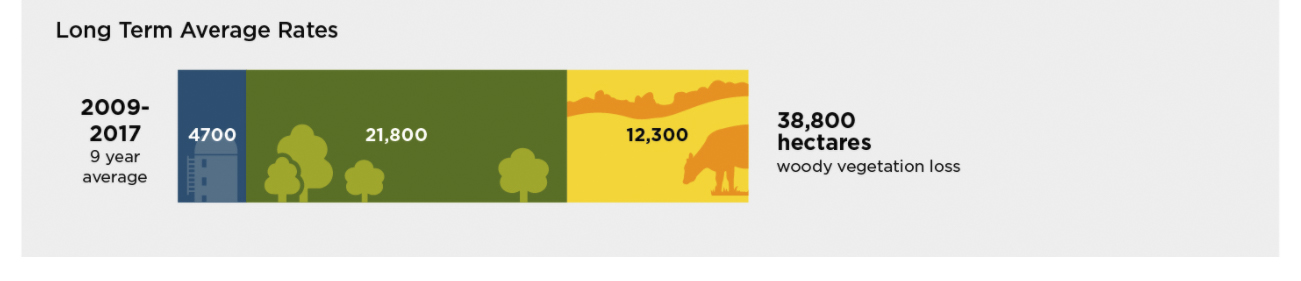
Land Clearing In NSW
Land clearing in NSW in the past few years is far above that of the previous decade as a result of the Berejiklian government’s relaxed vegetation laws. In particular three quarters of clearing of non-woody vegetation on regulated rural land was unexplained because it was either illegal or did not require environmental approval.
"NSW lost the equivalent of Sydney’s CBD to clearing for farming, forestry and other uses in 2019 every two days, continuing the accelerated deforestation pace that followed the loosening of native vegetation laws."
|
|
|
Ref: 2019 Landcover Change Reporting, NSW Dept. of Planning, Industry and Environment, accessed July 2021; Peter Hannam, NSW losing Sydney CBD-sized chunk of tree cover every two days to clearing, The Age, 29 June 2021. |
|
|
|
|
|
|
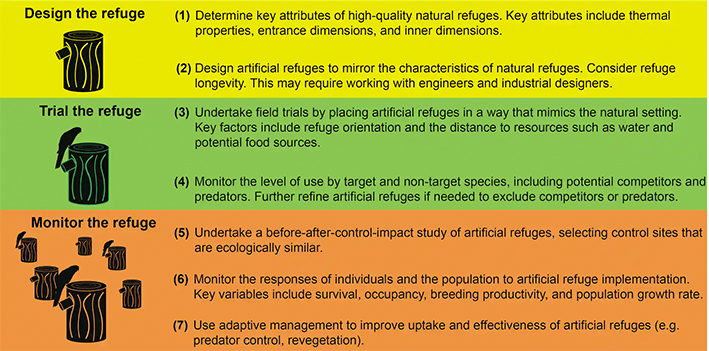
Artificial Refuges and Nest Boxes for Wildlife
As wildlife habitat is increasingly lost to land clearing, conservationists are turning to artificial refuges such as nest boxes to fill the gaps, particularly given that tree hollows can take up to 180 years to develop. However, the science behind the use of these refuges is weak and limited.
In Australia, government policies allow developers and mining companies to destroy wildlife habitat if they pay for offsets, that is conservation measures to compensate for the loss of habitat. These offsets often rely on artificial refuges.
"For example, one project in Australia relied heavily on nest boxes to offset the loss of old, hollow-bearing trees. But a scientific review of the project showed it to be a failure, due to low rates of uptake by target species (such as the superb parrot) and the rapid deterioration of the nest boxes from falling trees.”
|
|
|
|
|
|
|
Australia’s Poor Record on Species Conservation
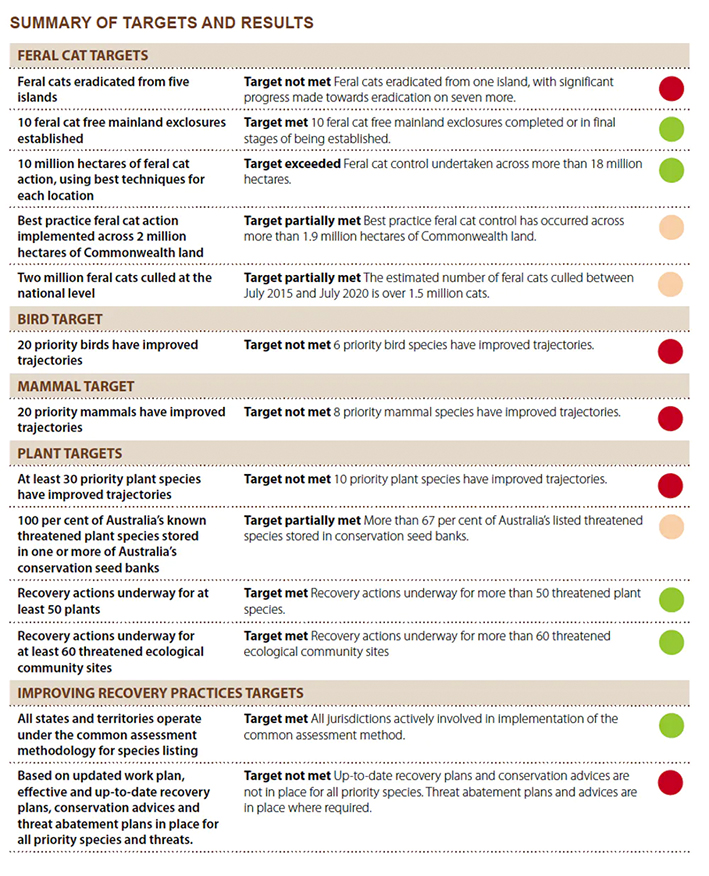
The targets and results of the government’s Threatened Species Strategy 2015-2020 are shown below. Although some targets were met, including some action on feral cats and plants, populations of priority bird and mammal species did not improve. "For the 24 out of about 70 priority species where population numbers were deemed to have ‘improved' over five years, about 30% simply got worse at a slower rate than in the decade prior. This can hardly be deemed a success.”
"What’s more, the populations of at least eight priority species, including the eastern barred bandicoot, eastern bettong, Gilbert’s potoroo, mala, woylie, numbat and helmeted honeyeater, were increasing before the strategy began – and five of these deteriorated under the strategy.”
The major threat to more than half the priority species was habitat loss, but the strategy did not address it, nor does the new Threatened Species Strategy 2021-2031. Addressing habitat loss would require stronger legislation and enforcement. However the trend seems to be going the other way.
|
|
 |
|
|
|
|
|
Some Pics from WIRES Mid-South Coast |
|
|
Flossie, Fee and all their friends. Care and photo by Zora Brown.
|
|
|
|
|
Bowie, a 619g swamp wallaby joey, delivered to Shelley by police at 2am in the night, now in care of Zora Brown. Photo by Shelley Clarke. |
|
|
|
|
Muffin, a swamp wallaby pinky, 280g, rescued at Broulee by Rachel O’Loughlin and Debbie Ellis. Now in a humidicrib at Nalda Paterson’s. Photo by Debbie Ellis. |
|
|
|
|
|
|
|
|
The reasonable cost of fruit for wildlife in care can now be reimbursed. Send your receipts to the branch treasurer Tony de la Fosse. |
|
|
|
|
|
|
The Secret Life of Echidnas
Listen to Dr Tahlia Perry discuss echidnas during this recorded 1 hour talk for the Lane Cove Council in NSW.
Zoom link: bit.ly/3wEuwTp
Password: @Echidnas#1 |
|
|
|
|
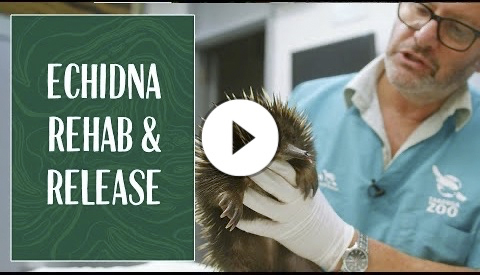
Echidna Rehab and Release at Taronga Zoo |
|
|
|
|
|
|
|
|
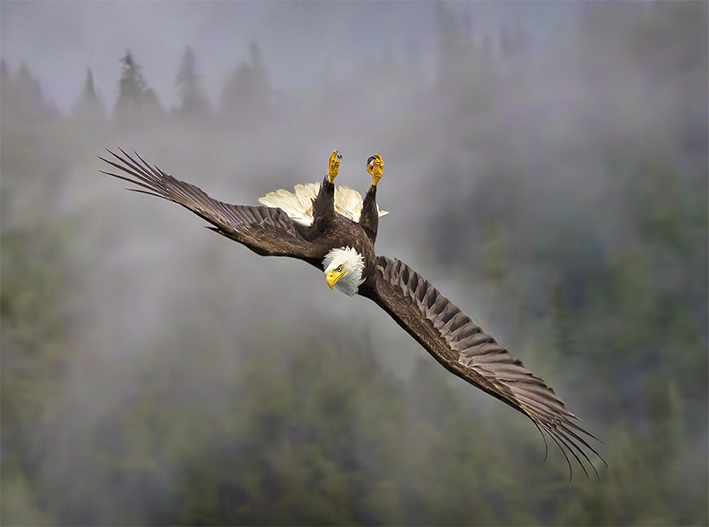
Contortionist by Dee Langevin |
|
|
|
|
|
|
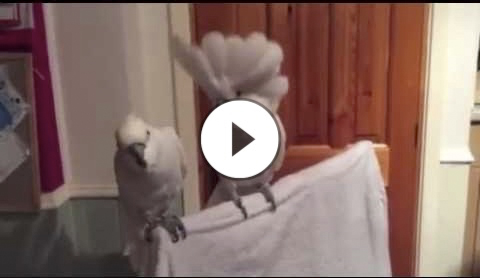
Featured YouTube: HIs Wife’s Just Not into Elvis |
|
|
|
|
|
|